
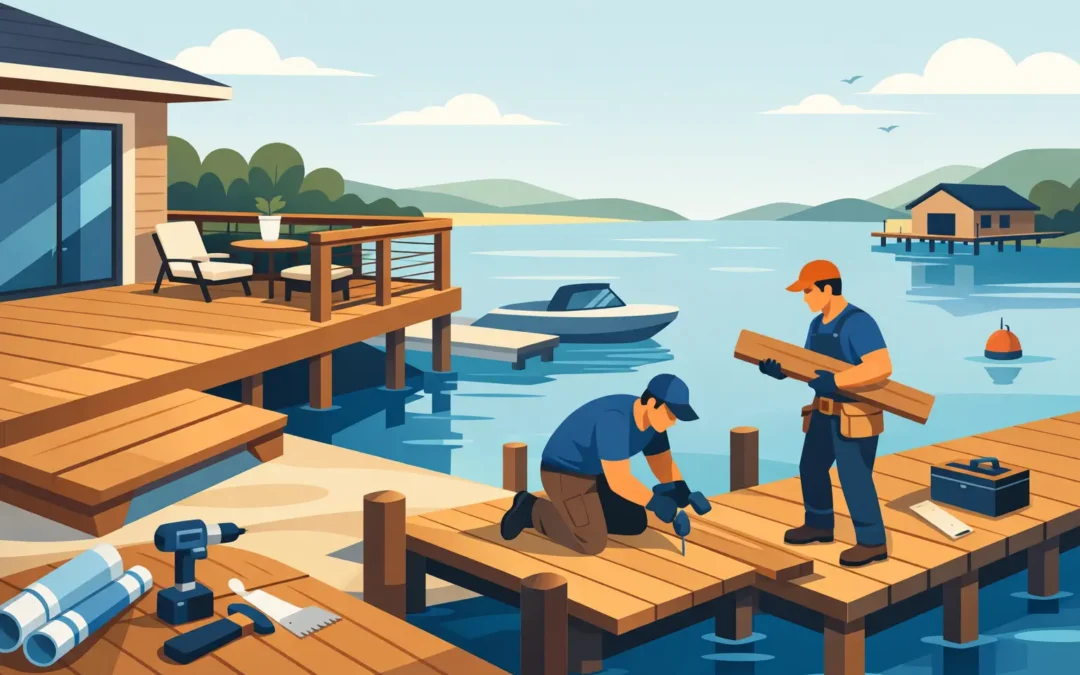
A deck at home and a dock at the cottage can look like two separate projects. In practice, they often raise the same question: who is actually equipped to build them properly?
That is where choosing the right contractor matters. A deck and dock builder should understand more than framing lumber and fasteners. They need to account for site conditions, changing water levels, drainage, frost movement, permit requirements, and how the finished structure will be used year after year in Ontario weather.
What a deck and dock builder should really handle
A lot of property owners start by thinking about appearance first. They picture the board colour, the railing style, the stair layout, or where to place a ladder at the shoreline. Those details matter, but the bigger issue is whether the structure is being planned as part of the property, not as a standalone add-on.
A capable deck and dock builder looks at access, grading, setbacks, load requirements, foundation conditions, and long-term maintenance from the beginning. On a residential build, that might mean tying a new deck into the house properly, planning stairs around an existing patio, or making sure the project does not create drainage problems near the foundation. At the water, it could mean addressing shoreline conditions, seasonal movement, and how people will launch, swim, or tie up watercraft safely.
That broader view is often the difference between a project that looks good on handover day and one that still performs well after several freeze-thaw cycles.
Why these projects are more technical than they look
Decks and docks are easy to underestimate because the finished product appears simple. Flat surfaces, posts, framing, railings. But the technical decisions underneath carry most of the risk.
For decks, the main issues usually involve support and water management. Ledger attachment, footing depth, beam spans, stair geometry, and railing compliance all need to be right. A deck that feels solid underfoot is not just a matter of using more lumber. It comes from proper engineering, proper fastening, and proper layout.
Docks bring a different set of variables. Shoreline access, lakebed conditions, fluctuating water levels, ice pressure, and seasonal removal or maintenance can all affect design choices. The right solution for one property may be wrong for the next. A fixed dock can work well in one setting, while another site is better suited to a floating or sectional approach. It depends on the shoreline, the water depth, and how the owner intends to use it.
That is why experience across both landscape and construction scopes matters. These jobs do not happen in isolation. They interact with the site around them.
Materials matter, but so does the setting
Clients often ask whether wood or composite is the better choice. There is no one answer.
Pressure-treated lumber remains a practical option for many decks because it is cost-effective and structurally reliable when detailed properly. Cedar can offer a different look and feel, but it comes with its own maintenance expectations. Composite reduces routine upkeep and can be a strong choice for clients who want a cleaner long-term ownership experience, though the upfront cost is higher and product selection matters. Not all composite boards perform the same way in direct sun or near water.
On docks, material choice becomes even more site-specific. Durability, slip resistance, heat retention, fastener performance, and seasonal movement all matter. A product that looks great on a backyard deck may not be the best choice at the shoreline.
This is where a practical builder earns their value. They should explain the trade-offs clearly instead of pushing one material on every job. Lower maintenance usually means higher upfront cost. Natural wood can be more budget-friendly at first, but it may need more attention over time. The right decision depends on budget, use, and the kind of ownership experience the client wants.
The design phase should solve problems early
The best deck and dock projects are usually the ones that feel straightforward during construction. That only happens when the design work has done its job.
A good plan should answer more than size and shape. It should address how people move through the space, where furniture will sit, whether privacy matters, how stairs meet grade, and how the new structure connects with the rest of the property. If the project is part of a larger outdoor build, the deck may need to relate to a pool, patio, outdoor kitchen, retaining wall, or cabana. At a cottage property, the route from the house to the dock may need grading, stone steps, lighting, or erosion control.
When those elements are handled by separate contractors, coordination gaps tend to show up quickly. Heights do not align. Drainage gets missed. One trade finishes before another problem is solved. Working with a contractor that understands the full site can prevent expensive rework.
That is one reason many clients prefer a design/build approach. Instead of trying to manage multiple companies for structural work, hardscaping, and finishing details, they can move the project through one team with one plan.
Permits, code, and shoreline considerations
Permits are not the exciting part of the job, but they matter. A contractor should be able to explain when permits are required, what approvals may apply, and how local conditions affect the build.
For decks, permit triggers can relate to height, size, attachment to the house, and structural details. For docks, requirements can vary based on the property, the body of water, and conservation or municipal considerations. Shoreline work can be especially sensitive, and assumptions can become costly if a project starts before approvals are understood.
This is another area where local experience matters. A builder working across York Region, the GTA, and Ontario cottage-country properties has likely seen the difference between a straightforward suburban deck build and a more complex waterfront installation. The process, constraints, and sequencing are not always the same.
Clients do not need a contractor who makes permits sound complicated for the sake of it. They need one who treats approvals as part of the job and plans for them properly.
What to look for when hiring a deck and dock builder
The first thing to look for is scope. Can the contractor handle only the structure, or can they also deal with the surrounding site work that affects the final result? If your project needs grading, stonework, lighting, railings, access paths, or integrated landscape features, that broader capability matters.
The second is track record. Years in business do not guarantee quality, but they do tell you the company has experience managing projects through changing conditions, products, and client needs. Established credentials and industry memberships can also help clients assess professionalism and accountability.
The third is how they talk about the work. A reliable builder should be direct about cost, schedule, material options, and limitations. If there are variables that may affect the job, they should say so early. Overpromising is easy in this industry. Delivering consistently is harder.
At Green Machine Inc., that practical approach is part of the value. Since 1999, the company has handled landscape, construction, and renovation projects that require more than one trade and more than one phase. For clients planning a deck, dock, or a larger property upgrade, that kind of full-scope capability can simplify the process considerably.
Cost is important, but value is not the same thing as price
Budget is always part of the decision. It should be. But the lowest quote on a deck or dock is not always the lowest cost over the life of the project.
A cheaper build can become expensive if it moves, drains poorly, weathers badly, or needs major correction within a few seasons. On the other hand, paying for premium materials where they are not necessary does not automatically add value either. Good planning means spending where it counts – on structure, site preparation, correct detailing, and materials suited to the location.
That is especially true for clients balancing several property improvements at once. If a deck is being built alongside a pool project, backyard renovation, or shoreline upgrade, the smartest investment is often the one that keeps the full project coordinated and built properly the first time.
The right build should feel finished, not just completed
A well-built deck or dock should not leave the owner with a list of unresolved issues. It should feel stable, fit the site, suit the way the property is used, and make sense with the rest of the work around it.
That is the standard worth aiming for. Not a quick build, not a flashy rendering, and not a price that only looks good before construction starts. A proper deck and dock builder should give you a structure that works hard, holds up, and looks like it belongs there. If you start with that expectation, you usually make better decisions all the way through the project.