
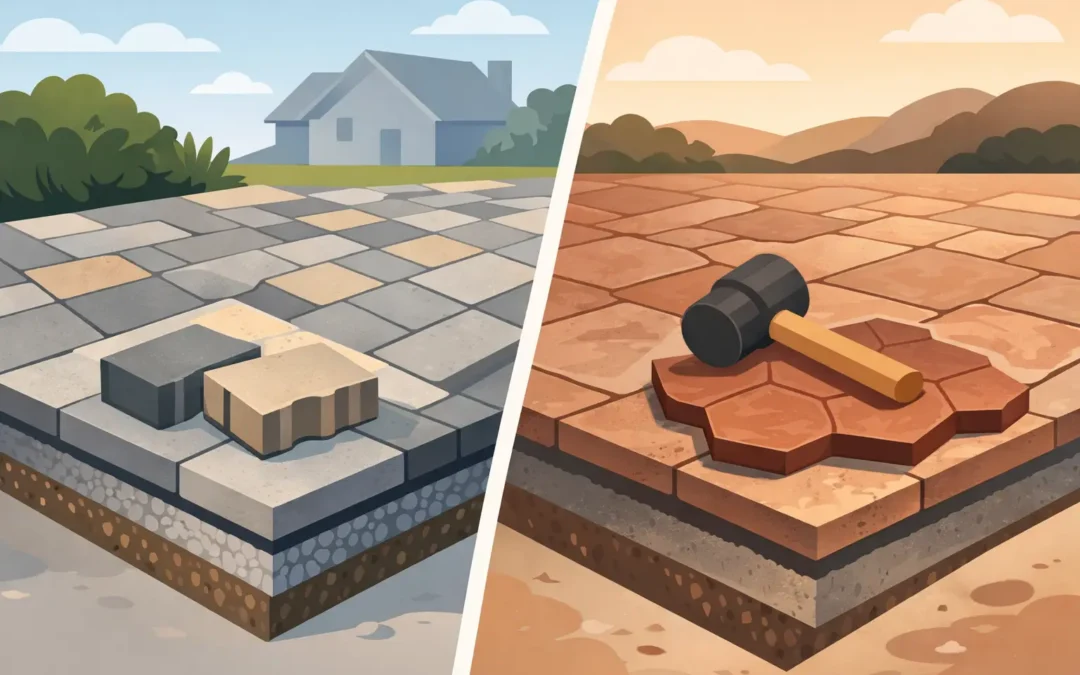
A driveway or patio has to do more than look good on installation day. In Ontario, it must handle freeze-thaw cycles, road salt, spring runoff, heavy vehicles and regular use. When homeowners ask whether to choose interlock or stamped concrete, the right answer depends on the surface, the property and how much future maintenance they are prepared to take on.
Both options can create a finished, high-value outdoor space. The difference is in how each system moves, drains and ages. A good decision starts with the base preparation and project design, not simply the colour or pattern selected from a sample board.
Interlock or Stamped Concrete for Ontario Properties
Interlock is made up of individual concrete pavers installed over a compacted granular base. The pavers lock together through their shape, edge restraint and jointing sand. Because it is a flexible pavement system, a properly built interlock surface can accommodate minor ground movement without becoming one large cracked slab.
Stamped concrete is poured as a continuous slab, then patterned and coloured to resemble stone, brick, slate or wood. It offers a clean, custom appearance with fewer joints and can be an attractive choice for patios, pool decks and walkways where a continuous finish suits the design.
Neither material corrects poor site conditions. If a driveway lacks enough excavation, a patio directs water toward the house, or drainage is ignored around a pool, the finished surface will eventually show it. This is why installation quality carries as much weight as the material itself.
Winter Performance and Ground Movement
Ontario weather is usually the deciding factor. Water enters small openings, freezes, expands and thaws repeatedly through the season. Soil can shift, settle or heave, particularly where drainage is poor or excavation is shallow.
Interlock is generally more forgiving in these conditions. Individual pavers can move slightly with the base, and a localized low spot can be lifted, rebuilt and reinstalled. Joints also allow water to move through the surface and into the prepared granular base, provided the base and drainage plan are built correctly.
Stamped concrete does not have that same flexibility. Control joints are installed to guide cracking, but they do not guarantee a crack-free slab. A small hairline crack may be manageable, while wider cracks, settling or heaving can be difficult to disguise in a decorative finish. The slab must be poured over a properly prepared base, at the proper thickness, with suitable reinforcement and drainage details.
That does not mean stamped concrete cannot work in Ontario. It can perform well on a stable, well-drained patio area with sound grading. It is simply less forgiving when the ground moves or water sits below the surface.
Appearance: Patterned Slab or Individual Pavers?
Stamped concrete creates a continuous visual field. It can suit contemporary backyards, formal patios and pool surrounds where fewer joint lines are preferred. Colour hardeners, stains and release agents allow for a broad range of looks, from subtle stone tones to more dramatic patterns.
Interlock offers more flexibility in layout. Pavers are available in traditional, modern and natural-stone-inspired profiles, and borders can define a driveway, terrace or walkway. It is also easier to combine interlock with natural stone steps, retaining walls, garden beds or an outdoor kitchen because the materials can be coordinated without forcing everything into one pattern.
For a front driveway, interlock often provides stronger curb appeal because the border and field pattern can be designed around the home. For a small patio where a smooth, continuous surface is the priority, stamped concrete may be the better visual fit. Sample panels help, but it is equally useful to review the material at full scale in natural light.
Cost Is More Than the Initial Quote
Stamped concrete can appear less expensive than premium interlock on some projects, especially when the area is open and straightforward. A large rectangular patio with easy access is efficient to form and pour. Complex stamping, multiple colours, demolition, difficult access and extensive preparation can change that number quickly.
Interlock pricing varies by paver selection, pattern, borders, cuts, excavation depth and base requirements. Driveways designed for vehicles require a more substantial base than a pedestrian walkway. Curves, steps, inlays and drainage work also add labour, but they can make the finished project more functional and complete.
The long-term cost picture matters. Interlock may require joint sand maintenance and occasional resetting, yet repairs are typically localized. If underground utility work, drainage repairs or a future landscape change requires access, the pavers can be removed and reinstalled.
Stamped concrete needs periodic cleaning and resealing to protect colour and finish. Repairing cracks or damaged areas can be more noticeable because matching an existing stamped pattern and colour is difficult. A low initial price is not always the lower lifetime cost.
Repairability and Access to Services
This is one of the clearest differences between the two choices. With interlock, a contractor can lift pavers in a settled area, correct the base and reinstall the same material if it is still available and in good condition. The same approach applies when access is needed for irrigation, drainage lines, electrical conduit or pool equipment.
With stamped concrete, access usually means saw-cutting and removing part of the slab. The repair can be structurally sound, but it may remain visible. Colour naturally changes over time from sun, weather and use, making a perfect match unlikely.
For properties planning a future pool, cabana, outdoor kitchen or drainage upgrade, interlock may offer practical flexibility. A comprehensive project plan can also avoid unnecessary removals later by placing services and sleeves before the finished surface is installed.
Drainage and Safety Around Patios and Pools
Water should move away from the house, garage and other structures. It should not pond on a patio, flow toward a foundation or wash soil out from garden edges. Both interlock and stamped concrete can be graded correctly, but the drainage strategy must be established before construction begins.
Interlock joints provide a degree of surface permeability, though standard interlock should not be treated as a complete drainage solution. The granular base, slope, catch basins, swales and outlet locations still need to be planned. Permeable paver systems are another option where stormwater management is a priority, although they require the right sub-base and site conditions.
Stamped concrete sheds water across its surface. That can be effective when the slab is pitched properly toward a suitable collection point. Around pools, the texture and sealer selection deserve special attention. Some stamped finishes can become slippery when wet, particularly if an overly glossy sealer is used. A contractor should recommend a finish suitable for wet-foot traffic.
Maintenance Requirements
Interlock benefits from routine sweeping, washing and joint sand replacement as needed. Polymeric sand can help stabilize joints and reduce weed growth, but it must be installed correctly and does not eliminate all upkeep. Avoid using aggressive de-icing products that can damage concrete pavers or surrounding stone.
Stamped concrete should be cleaned regularly and resealed according to the product and exposure conditions. Resealing helps preserve colour and makes the surface easier to maintain, but excessive sealer or poor application can create a patchy appearance. Salt use should also be limited, especially on newer concrete.
For both surfaces, prompt attention to drainage issues, settlement and surface damage is less expensive than waiting for a minor problem to spread.
Which Option Fits Your Project?
Choose interlock when repairability, drainage flexibility and a custom paver layout are priorities. It is often a strong fit for driveways, front entrances, walkways and larger outdoor living spaces where ground movement or future access may be a concern.
Choose stamped concrete when you want a continuous decorative surface, the area has stable conditions and you accept ongoing resealing and more complex repairs if cracking occurs. It can be a practical option for selected patios and pool areas with proper grading and installation.
A site visit should confirm soil conditions, existing grades, vehicle loads, water flow and how the surface will connect to the rest of the property. Green Machine Inc. has delivered landscape and construction projects across York Region and the GTA since 1999, with the design and build capability to assess the full scope rather than treating a patio or driveway as an isolated surface.
Before choosing a finish, ask for the proposed excavation depth, granular base specification, compaction process, drainage plan, edge restraint details and warranty terms. Those answers will tell you far more about the expected life of your driveway or patio than a showroom sample ever can.