
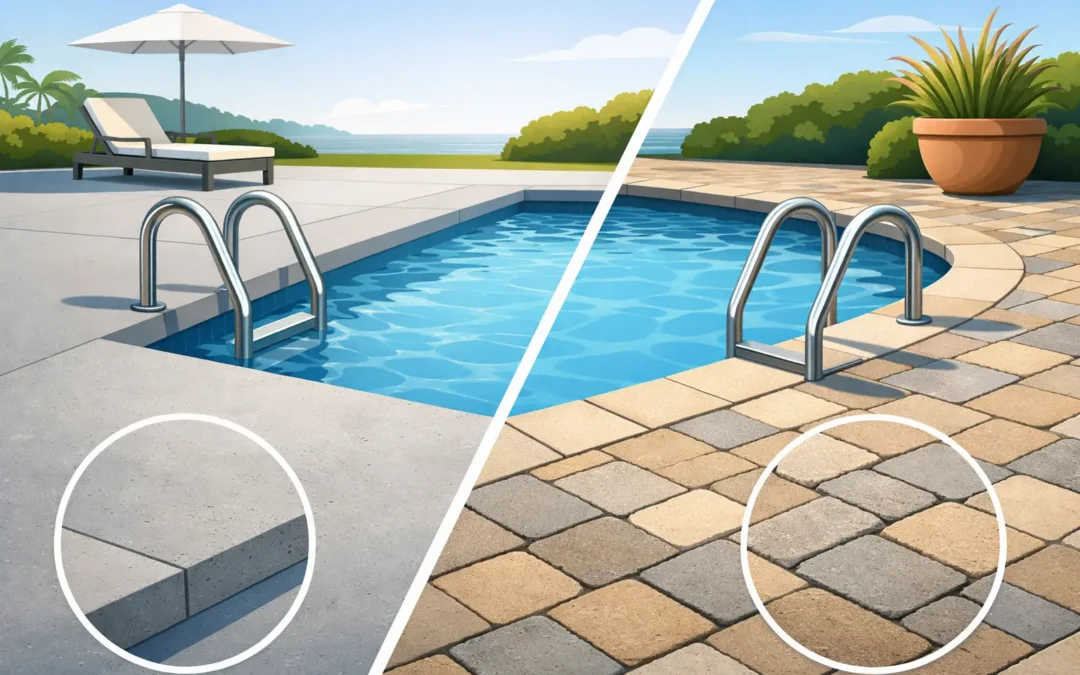
A pool deck gets judged fast. The first hot weekend of summer will tell you if the surface is too slippery, too hard on bare feet, or already showing cracks where winter did its work. When homeowners ask about pool concrete versus interlock, they are usually trying to avoid making an expensive mistake around one of the most used parts of the yard.
The right choice depends on how you use the space, what kind of look you want, and how much maintenance you are willing to take on over time. Around pools in Ontario, both materials can work well. The difference is in how they age, how they handle freeze-thaw conditions, and how much flexibility you want in the design and future repairs.
Pool concrete versus interlock – what is the real difference?
Concrete pool decking is a continuous poured surface. It can be finished in a few ways, including broom finish, exposed aggregate, stamped concrete, or brushed textures designed for traction. The main appeal is a clean, solid look and a broad surface without many joints.
Interlock is built from individual pavers laid over a prepared base. Those pavers come in a wide range of sizes, colours, textures, and patterns. The surface has joints between stones, which changes both the appearance and the way the deck performs over time.
At a glance, concrete often looks simpler and more monolithic. Interlock tends to look more custom and more detailed. Neither is automatically better. The better option is the one that suits the project conditions and the expectations for long-term upkeep.
Cost matters, but it is not the full story
Homeowners often start with price, and that makes sense. In many cases, standard poured concrete can come in at a lower upfront cost than a high-end interlock installation. That said, the number can shift based on finish type, site access, grading challenges, border details, and how much prep the area needs before work begins.
Stamped or decorative concrete can narrow the price gap. Premium interlock can push the budget further. If the pool area includes curves, built-in features, steps, retaining elements, or transitions into patios and outdoor living spaces, labour and design complexity become a bigger factor than the base material alone.
The more useful question is not which one is cheaper on day one. It is which one gives you the best value over ten or fifteen years. A lower initial cost can lose its advantage if repairs are difficult or if the finish does not hold up as expected in your setting.
How each material handles Ontario weather
This is where the decision gets more practical. Ontario pool decks deal with freeze-thaw cycles, spring movement, heavy rain, and seasonal temperature swings. That environment exposes weaknesses quickly.
Concrete is strong, but it is not flexible. Even with proper reinforcement and control joints, cracking is always a possibility. Some cracks stay minor and cosmetic. Others become more noticeable over time, especially if the sub-base shifts or water gets underneath and expands during freezing conditions.
Interlock has a different advantage. Because it is made of individual pavers on a compacted base, it can tolerate a degree of movement without creating one large visible failure. If an area settles or shifts, repairs are often more localized. Stones can be lifted, the base can be corrected, and the section can be reset.
That repairability matters around pools, where plumbing access, drainage corrections, or future renovations may require opening part of the deck. With concrete, patching is usually more visible. With interlock, it is often easier to blend a repair into the existing surface, assuming matching stone is available.
Comfort underfoot and slip resistance
Pool areas are walked barefoot. That changes the standard.
Concrete can be comfortable, but the finish matters a lot. Some decorative finishes retain more heat in direct sun, and darker colours can become uncomfortable during hot weather. A smooth finish may also create slip concerns when wet, which is why texture is essential around a pool.
Interlock tends to offer more built-in texture, which can help with traction. Some products also stay a bit more forgiving underfoot depending on colour and surface profile. Lighter tones generally perform better in direct sun whether you choose concrete or pavers.
This is one of those areas where showroom samples are not enough. A material may look great in photos and still be the wrong choice if it turns the deck into a hot surface by mid-afternoon. Practical use should carry as much weight as appearance.
Appearance and design flexibility
If your goal is a simple, modern pool surround, concrete can be a strong fit. It works especially well when the design calls for broad planes, minimal pattern, and a more architectural look. It can also pair cleanly with contemporary homes, cabanas, and outdoor kitchens.
Interlock gives you more options. It is easier to create borders, accents, curves, and transitions into walkways, driveways, steps, and surrounding landscape features. If the pool is part of a larger backyard plan, interlock often makes it easier to tie everything together.
That design flexibility becomes more valuable on properties where the pool area is not a stand-alone project. Many homeowners in York Region and across the GTA are not just building a pool deck. They are creating a full outdoor living area with seating, dining, privacy features, and graded access through the yard. In those cases, material continuity can improve the final result.
Maintenance is different, not absent
Neither option is maintenance-free.
Concrete may need sealing depending on the finish and exposure. It should also be monitored for cracking, surface wear, and scaling. Salt use, water chemistry, drainage issues, and winter exposure can all affect how well the surface holds up. Cleaning is usually straightforward, but repairs are not always invisible.
Interlock requires its own upkeep. Joint sand may need replenishment, weeds can appear if maintenance is neglected, and some areas may need resetting over time if settlement occurs. Sealing is optional in some cases and beneficial in others, depending on the product and the look you want to maintain.
The difference is that interlock maintenance is often more modular. Concrete maintenance is simpler until something significant goes wrong. Then the repair conversation can become less forgiving.
Drainage and installation quality decide a lot
This part gets overlooked, but it should not. The success of both materials depends heavily on base preparation, grading, drainage, and installation quality. A well-built concrete deck will outperform a poorly installed interlock job. A properly installed interlock deck will outperform concrete placed over weak prep.
Around pools, drainage matters even more because water is constant. Splash-out, rain, surrounding grade, and runoff all affect how the surface performs. Poor drainage can lead to settlement, staining, slippery areas, and winter damage.
This is where working with an experienced design/build contractor has a real advantage. If the pool, hardscape, grading, and adjacent structures are being planned together, the finished project is less likely to develop those all-too-common transition problems where one trade blames another. Green Machine Inc. approaches these projects as full-scope builds, which is often the better route when the pool area connects to multiple landscape and construction elements.
When concrete makes more sense
Concrete is often the better fit when you want a clean, uniform look and you are aiming for a more streamlined design. It can also make sense when budget is a major driver and the deck layout is relatively simple.
It works well for homeowners who prefer fewer visible joints and do not mind the reality that cracking can happen, even in a properly installed slab. If the site conditions are stable and the finish is chosen carefully for traction and comfort, concrete can be a solid long-term option.
When interlock makes more sense
Interlock usually stands out when long-term flexibility matters. If you want a custom appearance, better integration with surrounding hardscape, and easier localized repairs, it is hard to ignore.
It also makes sense on properties where movement is a concern or where the pool deck may eventually connect to future phases like a patio expansion, retaining wall, or outdoor kitchen. The ability to lift and reset sections can save money and frustration later.
The better question to ask before choosing
Instead of asking whether pool concrete versus interlock has one right answer, ask what your yard needs the deck to do. Does it need to match a new front walkway or driveway? Do you expect heavy entertaining? Is barefoot comfort a top concern? Are you building for resale, long-term family use, or a cottage property that sees harsher seasonal swings and variable maintenance?
Material decisions around a pool should not be made from price alone or from a photo gallery alone. They should be made from how the space will function, how the property is built, and how much long-term performance matters to you.
A good pool deck should still look right after several Ontario winters, not just on installation day. That is usually the clearest way to make the call.