
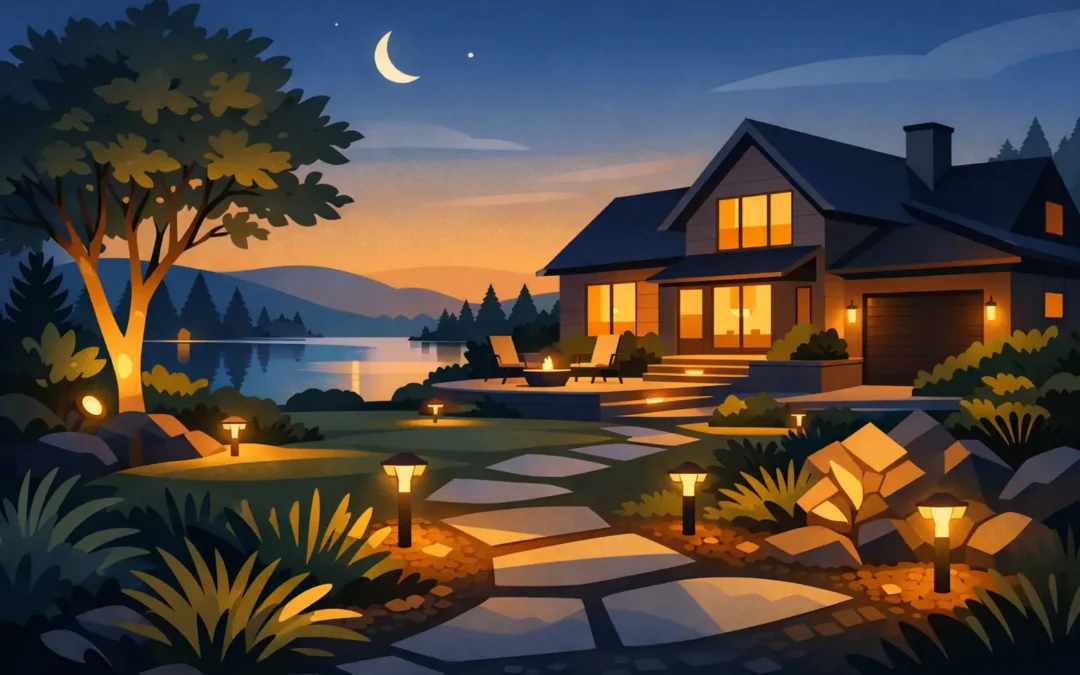
A well-designed landscape can disappear after sunset, or it can become a safer, more useful part of the property. This landscape lighting design guide explains how to plan exterior lighting that improves visibility without making a home, patio, pool area, or garden feel overlit. The goal is not to put a fixture on every feature. It is to direct light where people walk, gather, arrive, and enjoy the view.
For Ontario properties, the plan also needs to account for snow, freeze-thaw cycles, wet conditions, mature planting, and long winter nights. Good lighting is built into the overall landscape design, not treated as an afterthought once the hardscaping is complete.
Start With How the Property Is Used at Night
Before choosing fixtures, walk the property after dark. Stand at the driveway, front entry, rear patio, pool deck, side yard, and main garden views. Identify where people need light to move safely and where light will make the space more inviting.
A front-yard plan usually focuses on arrival, address visibility, walkways, steps, and architectural features. A backyard plan may need to support dining, cooking, pool use, dock access, or quiet seating. Cottage-country properties often need carefully controlled lighting that improves safety while respecting darker surroundings and neighbouring sightlines.
This first walk also reveals a common mistake: lighting every object equally. A property looks better when there are darker areas between focal points. Contrast gives the landscape depth. Too much uniform brightness can flatten stonework, wash out planting beds, and create glare at windows.
Build the Plan in Layers
The most effective landscape lighting design uses several light layers. Each has a clear job, and together they create a balanced result.
Safety and access lighting
Safety lighting comes first. Paths, steps, grade changes, gates, driveway edges, and transitions between a deck and yard should be easy to read at night. Fixtures should reveal the walking surface without shining directly into a person’s eyes.
Low path lights can work well along formal walks, but they are not the only solution. Downlights mounted in trees, structures, or posts can cast a more natural pattern across a path. Step lights suit retaining walls, stair risers, and raised patios. For a long driveway, modestly lit entry columns, wall fixtures, or carefully placed bollards may be more effective than lining the entire drive with fixtures.
Avoid placing lights too close together. A series of bright dots can create alternating glare and shadow, making the path harder rather than easier to navigate.
Architectural lighting
The house, garage, cabana, pergola, and stone features deserve selective attention. Uplighting can emphasize a masonry wall, gable, column, or mature tree near the front elevation. Grazing light across textured stone can be effective, although the fixture needs careful aiming. If the light is too close or too strong, imperfections and surface stains become more obvious.
Aim for a few intentional focal points. Lighting every wall, shrub, and roofline usually produces a commercial look. At the front of a home, two or three well-chosen features often create more impact than a dozen fixtures.
Outdoor living and task lighting
Patios and pool areas need a different approach from front entrances. People need enough light to cook, carry food, use stairs, and move around the perimeter, but a bright overhead floodlight can ruin the atmosphere.
Use task lighting where work happens: at an outdoor kitchen, barbecue, serving counter, change area, or storage access. Then add lower-level ambient light around seating and circulation areas. Under-cap lighting on seat walls, lights integrated into pergola posts, and controlled downlighting from nearby trees or structures can provide useful illumination without overwhelming the space.
Around pools, lighting should support safe movement and meet the requirements of the equipment, fencing, and electrical installation. Pool water, coping, steps, and adjacent decks reflect light differently. The layout should be planned alongside the pool build and hardscape design, not installed independently after the fact.
Feature and planting lighting
Trees, specimen shrubs, boulders, water features, and ornamental grasses give a yard character at night. The best targets have a strong form, interesting texture, or movement. A mature multi-stem tree may warrant two fixtures from different angles, while a small shrub may need none.
Consider the view from indoors as well. In winter, when gardens are sparse, evergreen planting, structural branches, stone walls, and ornamental grasses can carry the night scene. In summer, leafy canopies will block and redirect light, so fixture placement needs room for seasonal growth.
Choose Fixture Types for the Site
Fixture choice affects performance, maintenance, and appearance. Quality materials matter in the GTA and York Region, where salt, moisture, frost, and routine lawn care can shorten the life of poorly made equipment. Brass and copper fixtures develop a natural patina and generally hold up well. Powder-coated aluminium can be suitable for certain applications, but quality varies considerably.
Use purpose-built fixtures rather than trying to make one type do every job. Path lights, well lights, directional spotlights, step lights, hardscape lights, wall lights, and downlights each control light differently. A directional fixture with an adjustable shroud gives more control than a broad, exposed lamp.
LED systems are the standard choice for most residential projects because they use less energy, last longer, and work well with low-voltage systems. Colour temperature matters just as much as efficiency. Warm white light, often around 2700K to 3000K, generally suits brick, natural stone, wood, and planting. Cooler light can make a residential landscape feel stark, particularly against snow.
Control Glare Before It Becomes a Problem
A fixture can be technically installed correctly and still be unpleasant to live with. Glare happens when the light source is visible from normal viewing angles or when it reflects off pale paving, water, windows, or polished stone.
Shield fixtures wherever possible. Keep lamps below eye level, aim beams away from windows and neighbouring properties, and use louvers or glare guards when appropriate. Test the system from the driveway, the front sidewalk, indoor seating areas, and the neighbour-facing property line.
This is especially important for homes with large rear windows, glass railings, or reflective pool finishes. A lighting plan should enhance the view out, not turn the glass into a mirror at night.
Plan Wiring Before Hardscaping and Planting
The best time to plan lighting is before interlock, retaining walls, decks, gardens, or pool finishes are installed. Conduit can be run beneath walkways, sleeves can be built through walls, and wiring routes can avoid future digging. Retrofitting is possible, but it may involve lifting pavers, trenching through finished beds, or accepting less-than-ideal fixture locations.
Low-voltage lighting is common for landscape applications, but it still requires correct transformer sizing, cable runs, connections, and voltage management. Longer runs and larger fixture counts need proper design so lights at the end of the line do not appear noticeably dimmer. For line-voltage work and any electrical connections governed by Ontario requirements, use qualified electrical professionals and ensure the installation is completed appropriately.
Controls should be decided early as well. A simple photocell and timer may be enough for a front yard. Larger properties may benefit from zoning, dimming, app-based controls, or separate schedules for entry, entertaining, and feature lighting. More control is not always better. The system should remain easy for the homeowner to operate.
Budget for the Full System, Not Just Fixtures
Landscape lighting costs depend on the number and quality of fixtures, transformer capacity, wire runs, controls, access conditions, and integration with other construction. A small front-yard refresh may be straightforward. A full property with a pool, outdoor kitchen, long driveway, retaining walls, and mature trees needs a more detailed plan.
Do not reduce the budget by choosing the cheapest fixtures and connections. Exterior lighting is exposed to water, soil movement, snow clearing, and accidental impacts. The better value is a system with durable components, accessible connections, and a layout that can be expanded later.
Maintenance is modest but necessary. Fixtures should be checked seasonally for plant growth, shifted aim, debris, damaged lenses, and loose connections. Trees and shrubs change over time, and a system that looked balanced in the first year may need adjustment after a few growing seasons.
Make the Lighting Part of the Build
Lighting works best when it supports the whole property plan: the driveway arrival, the front entrance, the interlock pattern, the retaining wall, the outdoor kitchen, and the backyard gathering areas. For multi-trade projects, coordinating these decisions during design and construction prevents unnecessary rework and helps maintain a consistent finish.
Green Machine Inc. plans landscape lighting as part of complete exterior design/build work, including pools, patios, stonework, decks, and outdoor living spaces. The right system should make the property easier to use after dark while still allowing the landscape, not the fixtures, to take centre stage.