
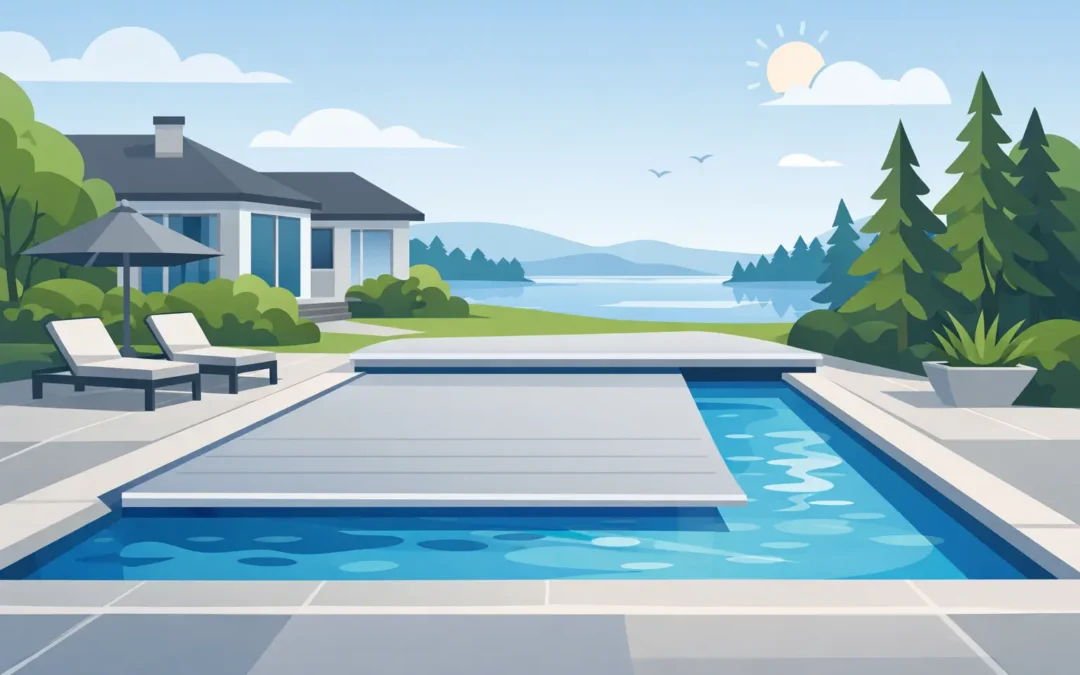
An automatic pool cover can be one of the most useful upgrades in a backyard pool project, but only when it is specified correctly from the start. This automatic pool cover review looks past the sales pitch and focuses on what Ontario homeowners need to weigh: safety, operating convenience, heat retention, construction requirements, maintenance, and the realities of winter.
For a new custom pool, the cover system should be discussed during design, not added as an afterthought. The mechanism, recessed housing, track layout, coping details, drainage, electrical supply, and surrounding patio all affect how well the cover performs and how clean the finished space looks.
What an Automatic Pool Cover Actually Does
An automatic pool cover is a motorized fabric cover that travels across the pool on tracks. With a key switch, wall control, or approved control system, it opens and closes over the water without the manual handling required by a solar blanket or winter cover.
Its most immediate benefit is convenience. When closing the pool takes less than a minute, homeowners are much more likely to use the cover every evening, during bad weather, or when the pool will sit unused for several days. That regular use is where the operating savings and maintenance benefits begin to add up.
A properly specified cover can reduce evaporation, retain heat, limit wind-blown debris, and reduce chemical loss. For heated pools, less overnight heat loss may also reduce the run time required from the heater or heat pump. The exact savings depend on pool exposure, water temperature, wind, shade, and how consistently the cover is used.
Safety Is the Main Reason to Consider One
For many homeowners, the strongest case for an automatic cover is added safety. A true safety-rated automatic cover is designed to support a specified load when closed and properly secured. It creates a barrier over the water that can help reduce the risk of accidental entry.
That distinction matters. Not every motorized cover provides the same level of protection, and a floating blanket is not a safety cover. Ask for clear product documentation, operating instructions, warranty details, and confirmation of the cover’s intended safety rating before making a decision.
A pool cover is also not a replacement for municipal pool enclosure requirements, compliant gates, alarms where required, or active adult supervision. In York Region, the GTA, and cottage-country communities, bylaw requirements can vary by municipality. The pool design should account for the applicable rules before construction begins.
A cover only performs as intended when it is closed fully and used consistently. Homeowners should also keep the control key or operating device out of reach of children, inspect the system regularly, and make sure guests understand that the cover is not a play surface.
Automatic Pool Cover Review: The Real Advantages
The best automatic covers solve several practical problems at once. They make daily pool ownership easier, keep the water cleaner, and improve the look of the pool area when the cover is concealed below the deck line.
The strongest advantages include:
- Reduced evaporation and heat loss, particularly on exposed or heated pools.
- Less debris in the water, which can reduce skimming, vacuuming, and filter cleaning.
- Faster closing and opening than a manual blanket, making regular use more realistic.
- Added safety when a properly rated cover is installed, operated, and maintained correctly.
- A cleaner finished appearance when the roller, housing, and tracks are integrated into the pool design.
There is also a comfort factor that is difficult to put into a quote. A pool that stays warmer, cleaner, and easier to manage is more likely to be used. For busy households and weekend properties, that can be worth as much as the utility savings.
The Trade-Offs Homeowners Should Know
Automatic covers are premium equipment. They add meaningful cost to a pool project, and the final number varies with pool size, shape, track type, cover material, concealment details, electrical work, and site conditions. Retrofitting an existing pool is possible in some cases, but it is usually more visible and can be more complicated than including the system in a new build.
Shape matters. A straightforward rectangular pool is generally the most cover-friendly layout. Freeform pools, large-radius corners, tanning ledges, raised walls, water features, and unusual deck geometry may require a more specialized approach or may limit available cover options. This does not mean a custom pool cannot have a cover. It means the design team must resolve the details early.
The cover itself needs care. Fabric can collect leaves, dirt, and standing water. Tracks need periodic cleaning. The mechanism, ropes, pulleys, and motor require inspection and occasional service. A neglected cover can drag, bind, or wear unevenly, especially where trees drop needles, blossoms, or heavy leaf debris into the pool area.
An automatic cover should not be confused with a Canadian winter cover. In Ontario, many pools still require a separate winterization plan that accounts for snow load, ice, freeze-thaw conditions, and off-season debris. The suitable approach depends on the manufacturer, pool construction, local conditions, and whether the property is occupied year-round.
Built-In Versus Top-Mounted Systems
A built-in system is usually the preferred choice for a new pool. The roller and mechanism are concealed in a recessed vault at one end of the pool, often beneath a removable lid or integrated deck detail. This gives the project a cleaner appearance and protects the equipment from view.
However, built-in systems need careful coordination. The vault requires drainage, access for servicing, structural planning, and enough room to accommodate the mechanism. Coping, decking, and adjacent landscape features must be planned so the cover can travel freely and the service area remains accessible.
Top-mounted systems place the roller above the deck at the end of the pool. They can be a practical option for certain retrofits or projects with limited room for a recessed vault. The compromise is visual: the roller and housing remain visible unless they are screened with a designed enclosure or bench detail.
Neither approach is automatically better. For a new high-end backyard, concealed equipment is often worth the added planning. For an existing pool where major reconstruction is not planned, a top-mounted system may offer a sensible path to better coverage and convenience.
Questions to Ask Before You Approve the Design
Before selecting a cover, confirm whether it is being installed primarily for safety, energy savings, debris control, or all three. That answer affects the product, controls, track configuration, and budget.
Ask how the system will be accessed for service, where water in the cover vault will drain, and whether the electrical connection is included in the pool scope. Confirm who is responsible for coordinating the cover supplier, pool builder, electrician, concrete work, stone coping, and surrounding patio. These are small details on paper, but they can create avoidable delays when different trades are not working from one plan.
Also ask what is excluded. Does the price include a lid or cover housing finish? Is a winter cover separate? What routine maintenance is expected? What is the warranty on the fabric, motor, ropes, and controls? A clear quote should separate the pool cover system from related construction work rather than leaving those items open to interpretation.
For homeowners planning a full backyard build, this is where a single design/build team can simplify the job. Green Machine Inc. coordinates pool, landscape, stonework, decking, drainage, and construction details so the cover is considered alongside the entire outdoor space rather than treated as a late-stage accessory.
Is an Automatic Cover Worth the Cost?
It depends on how the pool will be used. A homeowner who heats the pool, wants a cleaner water surface, has children or visiting families, and expects to close the pool most nights will typically see greater value than someone who uses an unheated pool occasionally and prefers a low initial project cost.
It is also a strong fit for cottage properties and homes where the pool may sit unattended between visits. Closing the cover can reduce debris accumulation and provide an added layer of protection while the property is empty. It does not eliminate the need for regular checks, but it can make ownership more manageable.
The right question is not whether every pool needs an automatic cover. It is whether the cover supports the way your household will actually use, heat, maintain, and secure the pool. When the system is built into the design and matched to local conditions, it can be one of the few pool upgrades that earns its place every day.