
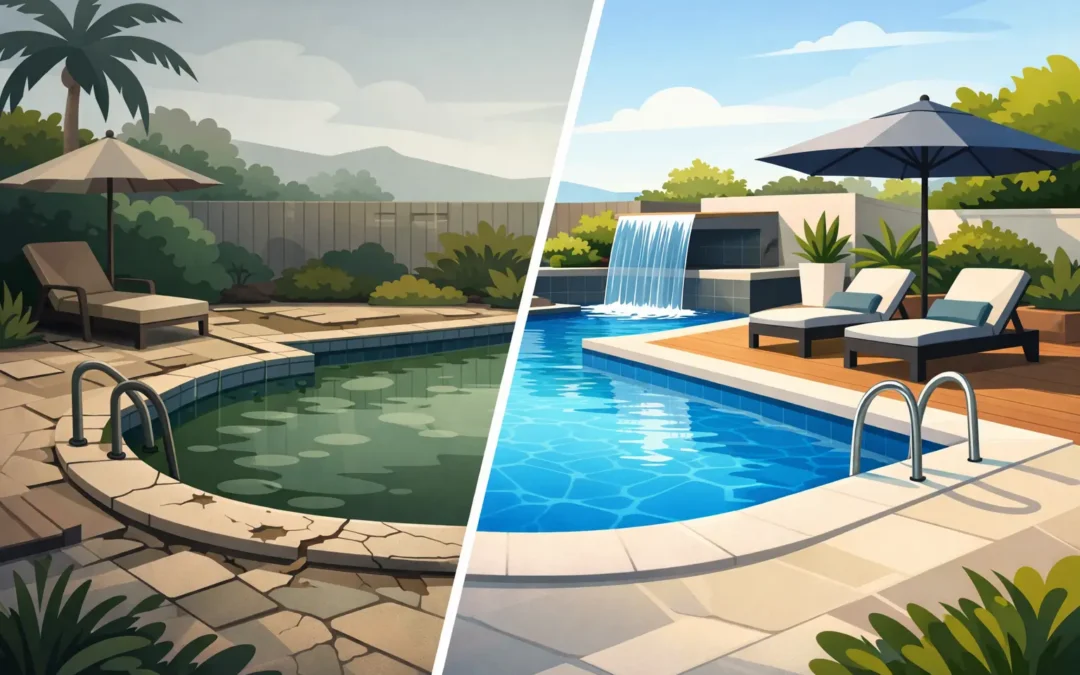
A tired pool rarely looks bad because of one issue alone. More often, the waterline tile is dated, the coping is worn, the patio has shifted, drainage is poor, and the whole backyard feels disconnected. That is why a true pool makeover before and after is not just about changing the pool finish. It is about correcting the surrounding space so the pool works better, lasts longer, and finally looks like it belongs on the property.
For homeowners planning a major upgrade, the biggest mistake is treating the pool as a stand-alone feature. In practice, the best transformations happen when the pool, deck, grading, stonework, lighting, and outdoor living areas are planned together. The visual change matters, but the functional change is what makes the investment worthwhile.
What actually changes in a pool makeover before and after
Most before-and-after photos focus on surface improvements because they are easy to see. Fresh liner colours, modern coping, new interlock, and clean waterline tile make an immediate difference. But the strongest projects usually solve hidden problems at the same time.
An older pool area may have poor drainage that pushes water toward the house or leaves sections of the patio heaving after winter. It may have cracked concrete, unsafe transitions, outdated equipment access, or a layout that leaves very little usable space for seating and movement. A proper renovation addresses those issues while improving the appearance.
This is where design/build experience matters. Replacing a liner or refinishing a surface is one task. Reworking elevations, rebuilding hardscape, adding retaining walls, integrating lighting, and creating a better backyard layout is a larger construction project. If the scope is handled in pieces by different trades, details often get missed.
The biggest visual upgrades homeowners notice first
The most dramatic before-and-after changes usually come from a few key areas. The first is the pool surround. Old broom-finished concrete or dated patio stone can make even a structurally sound pool look past its prime. Replacing that surface with new interlock or natural stone changes the entire setting and can make the pool feel newer than it is.
The second is coping and edge treatment. Worn coping draws the eye for the wrong reasons. Clean, updated coping creates a sharper border and helps tie the pool to the rest of the landscape.
The third is material consistency. Many older backyards were built in stages over several years, so the pool area does not match the front walk, side yard, steps, or retaining features. A makeover often looks so effective because it removes that patchwork feel. When the materials, colours, and lines are coordinated, the yard looks intentional instead of assembled.
Lighting also deserves more attention than it usually gets. Homeowners tend to focus on daytime photos, but a pool area is often used most in the evening. Low-voltage lighting, step lights, and subtle feature lighting around stonework or nearby structures can completely change the after side of the project without adding clutter.
Before and after is also about function
A pool renovation should make the space easier to use, not just easier to photograph. In many older yards, there is not enough deck space where people naturally gather. Seating areas are too tight, circulation is awkward, and there is no real transition between the house and the pool.
That can often be corrected by reworking the layout around the pool rather than changing the pool shape itself. Widening the deck in key areas, improving stair access, adding a cabana or privacy screen, and creating a better patio zone for dining or lounging can make the entire backyard feel larger.
There is also the issue of maintenance. A makeover is a good time to improve grading, drainage, and access to equipment. These are not the glamorous parts of a renovation, but they affect how the yard performs every season. In Ontario, freeze-thaw cycles expose shortcuts quickly. A good after result still needs to look good after several winters, not just on project completion day.
When a full pool area renovation makes more sense than a partial fix
Some projects only need selective updates. If the pool shell is in good condition and the surrounding hardscape is stable, it may be enough to replace coping, update tile, and refresh sections of the patio. That approach can control cost while still delivering a noticeable improvement.
But partial fixes have limits. If the deck has settled, the drainage is wrong, the retaining structures are failing, or the entire backyard layout feels dated, cosmetic upgrades alone will not hold up. In those cases, a broader renovation is usually the better long-term decision.
This is especially true for properties where the pool is only one part of a larger outdoor investment. If you are already planning new stonework, a deck, fencing, a covered structure, or an outdoor kitchen, it makes sense to approach the space as one coordinated project. That reduces rework and gives you a cleaner final result.
The design decisions that shape the best after photos
A strong pool makeover before and after result usually comes down to restraint. Too many materials, too many colours, or too many competing features can make a renovated yard feel busy. A better approach is to choose a clear direction and carry it through the whole space.
For a modern look, that often means cleaner lines, larger-format stone, simplified planting, and a controlled colour palette. For a more traditional backyard, warmer stone tones, defined garden beds, and softer transitions may fit better. Neither is automatically better. It depends on the house, the lot, and how the family uses the space.
Planting should support the renovation, not fight it. Oversized or messy plant material around a pool can increase maintenance and make the space feel crowded. The best landscapes around pools are usually planned for structure, privacy, and manageable growth. That may mean ornamental grasses, evergreen screening, low-maintenance shrubs, and carefully placed trees away from the water.
Budget expectations and trade-offs
Homeowners often start by asking what a pool makeover costs, but the more useful question is what the scope includes. There is a major difference between resurfacing a pool and rebuilding the entire surrounding environment.
A modest refresh may focus on liner replacement, coping updates, and selected repairs. A more complete transformation may involve demolition, new interlock or stone, drainage corrections, retaining walls, lighting, fencing changes, planting, and new outdoor features. Both are pool makeovers, but they are not the same category of project.
Trade-offs are part of the planning stage. If budget is limited, it is usually smarter to complete the structural and layout work first and leave some decorative additions for later. Good drainage, stable base preparation, and quality hardscape installation will matter longer than a few extra visual upgrades.
It is also worth being realistic about access. Tight backyards, sloped lots, and cottage-country properties can increase labour and material handling costs. Those site conditions do not make the project impossible, but they do affect scheduling and budget.
Why one contractor matters on complex pool renovations
Pool makeovers rarely stay in one lane. Once demolition starts, underlying issues often appear. Patio bases may be compromised. Existing grades may not support proper water flow. Old steps, fencing, or adjacent structures may need to be rebuilt to suit the new layout.
That is why many homeowners prefer one contractor that can manage pool-area construction, landscape work, stone installation, structural elements, and finishing details together. The process is more controlled, and the final result is more consistent. It also reduces the common problem of one trade blaming another when something does not line up.
For larger properties in York Region, the GTA, and Ontario cottage areas, that coordination becomes even more important. Access, timing, and material sequencing can affect the whole job. Green Machine Inc. has built its reputation on handling that broader scope under one brand, which is often what these renovations require.
What to look for in before-and-after examples
When reviewing project photos, look past the obvious finish changes. Check whether the after result improves layout, grading, access, and cohesion. A good renovation should make the space feel cleaner and easier to use, not just newer.
It also helps to ask what was replaced versus what was rebuilt. Some dramatic visual changes come from a full reconstruction around the pool, while others are selective upgrades done well. Both can be valid. The key is whether the scope matches the condition of the site.
The best pool renovations do not just erase age. They correct old compromises and turn the pool area into a proper extension of the property. If you are planning your own project, think beyond the waterline and look at the whole yard. That is usually where the real before-and-after difference begins.