
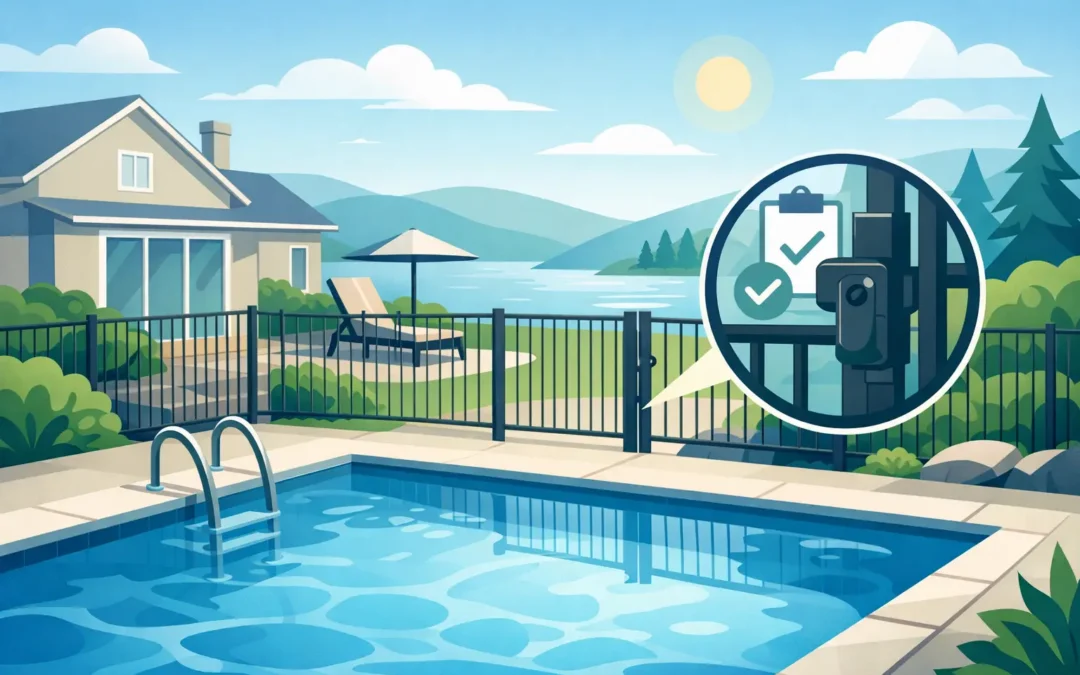
If you’re planning a new pool, the fence is not a finishing touch to think about later. Pool fence requirements affect layout, access points, grading, gate placement, and sometimes even where the pool can go on the property. Get that part wrong early, and the fixes tend to be expensive.
For homeowners in Ontario, the tricky part is that there is no single rulebook that applies the same way everywhere. The Ontario Building Code can affect parts of the project, but pool enclosure rules are often set and enforced at the municipal level. That means a backyard in East Gwillimbury may not be reviewed the same way as one in Markham, Georgina, or Richmond Hill. The broad safety goal is consistent. The exact fence height, gate hardware, setback expectations, and permit process can vary.
What pool fence requirements usually cover
In practical terms, pool fence requirements are there to prevent unsupervised access to the water. Most bylaws are written around a simple standard: the enclosure has to make climbing, squeezing through, or accidentally entering the pool area difficult enough to protect children and visitors.
That usually means the municipality will look at fence height, spacing between pickets or panels, clearance at the bottom of the fence, gate swing direction, self-closing hinges, and self-latching hardware. They may also regulate whether the house can form part of the enclosure, whether the wall of an above-ground pool counts as a barrier, and whether decks or raised platforms create access points that need their own protection.
This is where design decisions matter. A clean-looking glass fence, a decorative aluminum fence, a wood privacy fence, or a chain link enclosure can all perform differently under bylaw review. A material that works well on one property may not be accepted as proposed on another if grading, retaining walls, or nearby structures make climbing easier.
Why local bylaws matter more than assumptions
Many homeowners assume there is a standard “pool fence” product that automatically meets code. There isn’t. Compliance depends on the full installation, not just the fence style.
A common example is the bottom gap. A fence panel might be manufactured to an acceptable standard, but if the yard slopes away and leaves too much clearance underneath, the installation may fail inspection. The same goes for gates. A gate can look substantial and still fall short if it doesn’t self-close reliably or if the latch is mounted at the wrong height or in the wrong position.
Municipalities also differ on details that catch people off guard. Some require a separate pool enclosure permit. Some review the barrier as part of the pool permit. Some are strict about temporary fencing during construction. Others focus heavily on whether direct access from a deck, cabana, or rear door creates a hazard that needs extra protection.
For that reason, the safest approach is to treat pool fence planning as part of the pool design and site plan, not as an add-on after excavation starts.
Key pool fence requirements to confirm before construction
Before any materials are ordered, confirm the local standards for height, openings, gates, and setbacks. In many Ontario municipalities, the minimum fence height is often around 1.2 m to 1.5 m, but that range is exactly why assumptions create problems. A few inches can be the difference between passing and rebuilding.
Openings matter just as much. If horizontal members create an easy climb, or if spacing between pickets is too wide, the fence may not be accepted. Gates are usually required to be self-closing and self-latching, and they often must open away from the pool area. That hardware needs to work consistently, not just when it’s first installed.
If the property has grade changes, armour stone, retaining walls, raised patios, or stepped landscaping, those features should be reviewed together with the enclosure. A fence that is compliant on flat ground may become climbable when installed beside a raised planting bed or a low retaining wall. The same issue comes up with pool equipment pads, AC units, storage boxes, and nearby furniture. If a child can use an object to climb over the barrier, inspectors may flag the setup even if the fence itself looks correct.
Above-ground pools are not automatically exempt
Homeowners often ask whether an above-ground pool needs a separate fence. Sometimes the wall of the pool can serve as part of the barrier, but that depends on the pool height, the access system, and the local bylaw.
The weak point is usually the ladder or deck access. If a removable ladder is used, municipalities may still have specific expectations about securing access when the pool is not in use. If a deck surrounds the pool, that deck may trigger its own enclosure requirements. In other words, an above-ground pool can simplify one part of compliance while complicating another.
This is one of those cases where “it depends” is the only honest answer. The right solution depends on the pool model, the deck design, and the local inspector’s interpretation of the bylaw.
Fence design choices and their trade-offs
Aluminum fencing is a common choice because it is durable, low maintenance, and generally well suited to pool areas. It also provides visibility, which many homeowners want for safety and sightlines. The trade-off is privacy. If the yard backs onto neighbours or a road, you may want screening elsewhere in the landscape plan.
Glass fencing gives a premium look and keeps views open, especially around high-end pools and modern backyards. It can work very well, but it requires precise installation and ongoing cleaning. It is also less forgiving on uneven grades and often comes at a higher price point.
Wood fencing offers privacy and can tie into the overall yard design, cabana, or deck. It can also meet enclosure standards when properly built. The trade-off is maintenance and longevity. In a pool environment with moisture, splash, and seasonal movement, wood requires more attention over time.
Chain link may satisfy some bylaws, but many homeowners avoid it for appearance reasons. It can also present climbability concerns depending on the local standard and how the bylaw is written. Even if it is technically permitted, it may not be the best fit for a major backyard investment.
Construction timing matters
One of the biggest mistakes on pool projects is leaving fence decisions too late. If excavation starts before the enclosure plan is clear, crews may run into avoidable conflicts with access routes, utility locations, hardscaping, and drainage.
A well-planned project coordinates the pool, fence, gates, deck, interlock, retaining walls, and any structures such as a cabana or outdoor kitchen. That matters because each element can affect the enclosure. A gate can’t swing properly into a walkway if elevations are off. A retaining wall can’t create a climb assist beside the fence. A pool equipment area shouldn’t interfere with safe access or required clearances.
This is where working with a contractor that understands the full site, rather than just one piece of it, saves time. Green Machine Design Build handles pool construction, fencing, hardscaping, and broader exterior work under one scope, which makes these coordination issues easier to solve before they turn into change orders.
What to ask before you approve the plan
Ask who is responsible for confirming local bylaw requirements and permit obligations. Ask whether the submitted site plan shows the enclosure, all gate locations, grade changes, and nearby structures. Ask how temporary safety barriers will be handled during construction if required by the municipality.
It is also worth asking how the final inspection will be prepared for. That includes checking gate hardware, latch performance, bottom clearances, and any spots where landscaping or hardscaping may have altered the intended barrier height. These details are small on paper and expensive in the field.
If your property has unusual conditions – ravines, sloped yards, corner lots, lakefront exposure, shared boundaries, or older accessory structures – bring those up early. Pool fence requirements are straightforward on a clean, flat lot. They become more nuanced when the property itself adds complexity.
The smart approach for Ontario homeowners
The best way to handle pool fence requirements is to stop thinking of the fence as a separate purchase. It is part of the pool project, part of the permit conversation, and part of the long-term safety of the property.
That mindset changes the process. Instead of shopping for panels first and checking compliance later, you start with the bylaw, the site conditions, and the overall design. Then you choose a fence system that works with the pool, the yard, and the municipality’s expectations.
That approach usually costs less in the long run, causes fewer inspection issues, and results in a better finished property. A pool should improve how you use the yard, not leave you sorting out preventable compliance problems after the build is nearly done.
If you’re at the planning stage, the most useful next step is simple: confirm the local bylaw before the layout is finalized, and make sure the fence is designed with the rest of the project rather than around it.