
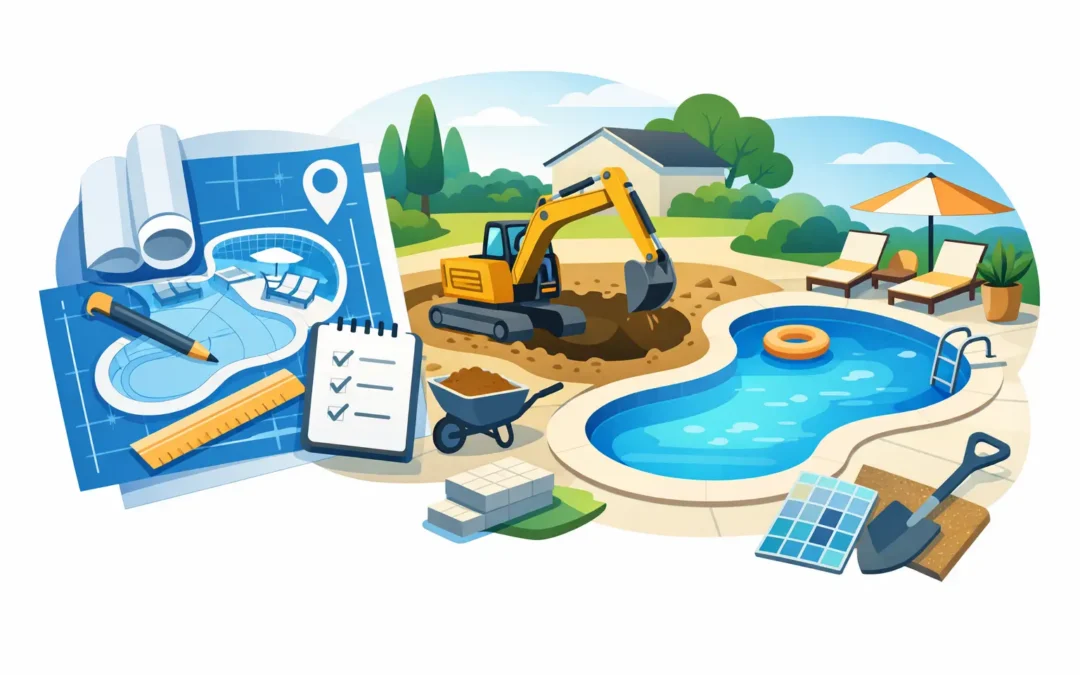
A good pool installation is decided before the excavator shows up. Most costly problems are not caused by the pool shell itself. They come from poor site planning, weak drainage, tight access, missed permit requirements, or treating the pool as a standalone job when it really affects the whole property.
For homeowners in Ontario, that matters even more. Our climate is hard on exterior construction, backyards often have grading challenges, and many projects involve more than a pool alone. Patios, retaining walls, fencing, outdoor kitchens, cabanas, lighting, and drainage all need to work together. If they do not, the backyard can look pieced together and cost more to correct later.
Pool installation is a full property project
The biggest mistake people make is pricing the vessel first and everything else second. A pool changes how the yard functions, how water moves, and how people use the space. It also affects access routes, setbacks, equipment placement, and how much room is left for seating, dining, and circulation.
That is why the best approach is to plan the yard as one coordinated build. If you know you want interlock, stonework, a pergola, privacy screening, or a full outdoor living area, those pieces should be designed at the same time as the pool. It avoids rework and gives you a cleaner final result.
This is especially true on properties with grade changes or limited space. A sloped yard may require retaining walls and careful drainage. A tighter suburban lot may need precise layout planning so the pool does not consume the entire backyard. At a cottage property, soil conditions, shoreline considerations, and equipment access may become the bigger issue.
What affects pool installation cost the most
Every owner wants a realistic number early, and that is fair. But the truth is that pool installation cost depends less on a single advertised base price and more on the conditions around the build.
Excavation complexity is a major factor. If access is tight, if there is poor soil, or if extra machine time is needed to protect the surrounding property, costs move quickly. The same goes for drainage work. A proper pool build has to respect grading and water management. Skipping that work may save money at the start and create expensive issues later.
Material selection also changes the budget. Coping, decking, fencing, lighting, and landscaping can move a project from functional to premium. Neither approach is wrong. It depends on how you plan to use the space and whether the goal is a simple swim area or a complete backyard environment.
Then there is the equipment side. Heating, automation, sanitation systems, and pool features like spillovers, water features, or integrated spas can all add value, but they should be chosen based on actual use. Not every upgrade pays off equally for every household.
The design questions worth answering early
Before drawings are finalized, it helps to be clear on how the pool will be used. A family with young children will prioritize safety, shallow areas, and clear sightlines from the house. A homeowner focused on entertaining may care more about patio space, lighting, and the relationship between the pool, dining area, and outdoor kitchen. A property owner planning for resale may want broad appeal and a layout that feels balanced rather than oversized.
Shape matters, but function matters more. Freeform pools can soften a landscape, while geometric designs often pair well with modern homes and structured hardscaping. The right choice usually comes down to the architecture of the house and the amount of usable yard space.
Placement is another major decision. A pool should feel connected to the home, not pushed into a leftover corner. At the same time, there must be enough room for circulation, maintenance access, and supporting features. Equipment location should be considered early so it is practical without becoming a visual distraction.
Permits, bylaws, and setbacks are part of the job
In Ontario, permit and zoning requirements can shape the layout as much as design preference. Fencing requirements, setbacks, grading rules, and utility considerations all affect where and how a pool can be built. This is one area where early planning saves real time.
Owners sometimes assume permits are just a formality. They are not. A design that ignores local requirements can stall a project or force revisions after money has already been spent on planning. That is one reason experienced design/build contractors are valuable on pool work. They know the process, and they know the practical issues that tend to appear once the site is reviewed in detail.
For larger properties, the process may feel straightforward, but even then there can be complications. For smaller lots in places like Newmarket, Aurora, Markham, or Richmond Hill, every foot matters. A layout that looks fine on paper can become problematic once setbacks, fencing, drainage, and access are all accounted for.
Drainage and grading are not optional details
If there is one part of pool installation that gets underestimated, it is drainage. Water has to go somewhere, and a pool project changes how it moves across your yard. Hard surfaces, retaining features, and the pool itself all influence runoff.
Without proper grading, you can end up with standing water, movement in surrounding hardscape, or pressure against adjacent structures. In freeze-thaw conditions, those mistakes become more expensive. This is why drainage planning should happen alongside the pool design, not after excavation.
The same goes for retaining walls and elevation changes. They are not just visual additions. On many sites, they are structural necessities that protect the long-term performance of the project. A well-built backyard looks good because it is engineered and constructed properly, not because decorative finishes were added at the end.
Timing a pool installation in Ontario
Most people think spring is the time to start planning a pool. In reality, spring is often when people wish they had planned earlier. Design, approvals, scheduling, and material coordination all take time. If the goal is to swim this season, late planning can narrow your options.
That does not mean a project should be rushed. A rushed pool job is more likely to create compromises in design, sequencing, or finish quality. It is better to plan properly and build with a clear scope than to force an unrealistic timeline.
Weather is another factor. Ontario construction seasons are workable, but rain, site conditions, and inspection timing can all affect progress. A professional schedule should allow for that. Straight answers on timing are better than promises that depend on everything going perfectly.
Why integrated construction matters
Pool projects rarely stay limited to the pool. Once work starts, homeowners often address old patios, failing decks, poor grading, fences, or unused lawn areas at the same time. That is usually the smart decision, but it only works well when the project is coordinated under one plan.
Managing multiple trades separately may look cheaper at first, but it often creates gaps in responsibility. One contractor blames the other. Details get missed. Finish levels do not align. Drainage is handled in pieces. The result is a backyard that feels assembled rather than built.
An integrated contractor can design and sequence the whole project so the pool, hardscaping, structures, and supporting construction work together. That matters whether the scope is a straightforward family pool or a more complete outdoor living build with stonework, cabanas, fencing, and entertainment areas. It is one reason property owners across York Region, the GTA, and Ontario cottage country often prefer one experienced company that can carry the full job from planning to completion.
Choosing a contractor for pool installation
A pool is not the place to buy on price alone. The better question is whether the contractor can manage the whole site properly. Experience matters, but so does scope. Can they handle grading, hardscape integration, structural features, and the practical realities of the property, or are they only strong on one piece of the work?
Look for a contractor who can explain trade-offs clearly. On some sites, spending more on access protection or drainage is the right call. On others, a simpler layout may deliver better long-term value than forcing in too many features. Straight advice is usually a good sign.
It also helps to work with a builder that has established history and the ability to deliver beyond a single specialty. Green Machine Inc. approaches pool projects as part of a complete design/build service, which is often the difference between a backyard that works for years and one that needs correction after the first few seasons.
A well-planned pool installation should make the property more usable, easier to enjoy, and stronger as an investment. If the planning is thorough from the start, the build tends to follow the same way.