
The wrong pool coping shows up fast. You feel it under bare feet, see it in the way water sheds off the edge, and notice it even more after a few Ontario freeze-thaw cycles. If you are figuring out how to choose pool coping, the decision is not just about appearance. It affects safety, comfort, maintenance, and how well your pool and surrounding hardscape hold up over time.
Pool coping is the cap or edging that finishes the top perimeter of the pool shell. It gives the pool a clean edge, protects the structure, and creates the transition to the deck or patio. Done properly, it looks intentional and performs quietly in the background for years. Done poorly, it can become slippery, stain-prone, or start shifting before the rest of the pool area shows much age.
How to Choose Pool Coping Based on Performance First
Most homeowners start with colour and texture. That makes sense, because coping is one of the most visible details around a pool. But performance should come first, especially in Canada.
A good coping material needs to handle water exposure, direct sun, changing temperatures, and winter movement. It should also feel comfortable on bare feet and provide enough traction when the deck gets wet. That is why the best choice is rarely the one that only looks good on a sample board.
Start by asking a few practical questions. Will the pool be used heavily by children and guests? Is the surrounding area formal and modern, or more natural and cottage-style? Are you trying to match existing interlock, stone steps, retaining walls, or a new backyard design? The right coping should work with the whole project, not fight against it.
Material Matters More Than Most People Think
Natural stone coping
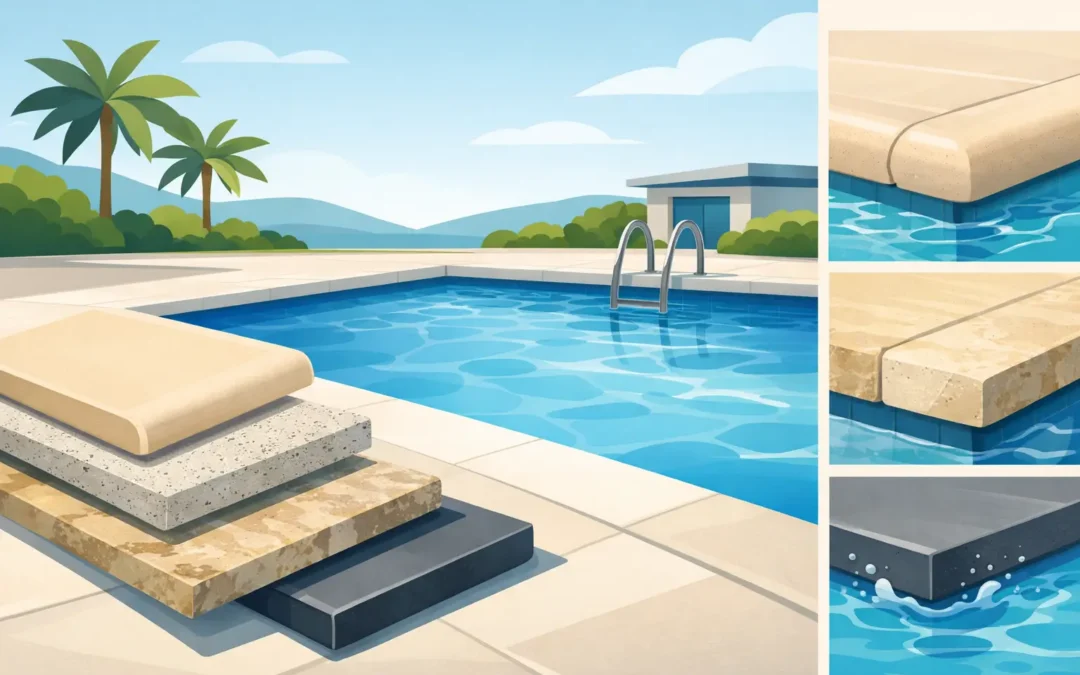
Natural stone is a strong choice when you want a premium finish and a more custom appearance. Options like limestone, granite, and some sandstones can create a clean, high-end edge. The benefit is character. No two pieces are identical, and the finished result often feels more integrated with quality landscaping and masonry.
The trade-off is variability. Some natural stones are more porous than others, and some need more maintenance to resist staining, salt, or weathering. In Ontario, the stone also has to be suitable for freeze-thaw conditions. Not every imported stone performs the same way in a Canadian backyard.
Precast concrete coping
Precast concrete coping is popular for a reason. It gives a consistent look, comes in a wide range of profiles and colours, and can be a practical fit for both traditional and modern pool designs. It is also often more budget-friendly than premium natural stone.
That said, quality varies. Better products are denser and more durable, while lower-grade options may be more prone to surface wear, fading, or moisture issues over time. If you are comparing quotes, this is one of the places where product quality and installation standards matter.
Poured concrete or cantilevered coping
Cantilevered concrete coping creates a clean, continuous look because the deck material extends right to the pool edge. For some homeowners, that minimal appearance is exactly the point. It can suit contemporary designs and works well when the goal is a more seamless visual line.
The downside is that repairs are less simple if cracking or movement occurs. Matching the finish later can also be difficult. If your backyard plan includes a lot of custom concrete work, this option can make sense, but it should be installed with proper detailing and realistic expectations.
Porcelain coping
Porcelain is becoming more common in upscale outdoor projects because it offers a refined look, strong colour consistency, and good resistance to staining and fading. Some products are specifically manufactured for outdoor use and can perform very well around pools.
This is not a category where you want to guess. Outdoor-rated porcelain for pool applications must be chosen carefully for slip resistance, edge finishing, and climate suitability. It can be an excellent option, but only when the product and install method are right.
Slip Resistance and Surface Temperature
A coping material can look perfect and still be a poor choice if it gets too slick or too hot. These are two of the most overlooked parts of how to choose pool coping.
Textured finishes generally provide better traction than polished ones, but there is a balance. Too rough, and the edge can feel abrasive on bare feet or when people sit along the pool perimeter. Too smooth, and safety drops when water is splashing across the surface.
Heat retention also matters. Darker materials often absorb more heat in direct sun, which can make the coping uncomfortable in peak summer weather. Lighter tones usually stay cooler and can brighten the whole pool area. For many Ontario homeowners, especially families, a lightly textured, lighter-coloured coping material is a practical middle ground.
The Edge Profile Changes the Look and Feel
Coping profile affects more than style. It changes comfort, water behaviour, and the visual character of the pool.
A square-edge or straight-edge profile gives a more modern, architectural appearance. It works well with contemporary homes, clean deck layouts, and rectilinear pool designs. A bullnose edge feels softer and more traditional, with a rounded front that can be more comfortable to grip or sit on. There are also drop-face and larger-format options for vanishing edges or elevated designs.
This is where the pool design and surrounding construction need to work together. A formal home with structured landscaping may suit crisp, straight lines. A more relaxed backyard or cottage setting may call for a softer profile and a more natural material.
Match the Coping to the Rest of the Backyard
Pool coping should not look like an afterthought. It connects the waterline to the patio, steps, walls, and outdoor living areas. If the pool is part of a larger landscape build, the coping choice should support the full design.
Matching does not always mean using the exact same material everywhere. In fact, too much repetition can flatten the look of the space. Often the better move is coordination. The coping can complement the patio stone, pick up a tone from a retaining wall, or create a clean border between the pool and the deck.
For example, a modern porcelain patio may pair well with a precise precast or porcelain coping. A backyard with natural stone steps, armour stone features, or a more traditional interlock layout may be better served by natural stone coping with some variation in tone and texture.
Think About Maintenance Before You Commit
Every coping material requires some care, but not all materials ask for the same level of attention.
Natural stone may need sealing depending on the product and exposure conditions. Lighter materials can show dirt less than expected, while some darker or more uniform finishes show water marks, sunscreen residue, and dust quickly. Concrete products may need periodic attention to joints and surface condition. Porcelain is generally low maintenance, but installation details still matter because grout lines, bedding, and surrounding movement all affect long-term performance.
If you want a backyard that stays sharp with minimal upkeep, be honest about that at the selection stage. A finish that looks outstanding in a showroom may not be the best fit if you do not want ongoing maintenance.
Budget Without Choosing on Price Alone
There is always a price conversation around coping, and there should be. But the lowest upfront number is not always the best value.
Material cost is only one part of the total. Fabrication, edge finishing, installation complexity, substrate preparation, and integration with the pool shell and deck all affect the final result. A cheaper coping product installed poorly can become more expensive than a better product installed properly the first time.
This is especially true on custom builds where the pool, patio, and surrounding hardscape need to perform as one system. Experienced design/build contractors look at the coping in context, not as a stand-alone line item. That approach usually prevents mismatched materials, awkward transitions, and future repair issues.
Questions Worth Asking Before Final Approval
Before you sign off on a coping selection, ask how the material performs in freeze-thaw conditions, whether the finish is suitable for wet bare feet, and how it will coordinate with the rest of the hardscape. Ask what kind of base and installation method will be used, how expansion and movement will be handled, and what maintenance is recommended after installation.
It is also smart to ask to see the actual product, not just a catalogue image. Samples are useful, but larger pieces tell you more about colour variation, texture, and edge detail. Around pools, those details matter.
For homeowners planning a full backyard project, this is one of the advantages of working with a contractor that handles both pool construction and the surrounding landscape and masonry work. The coping is not chosen in isolation. It is selected as part of a complete build so the finish, function, and transitions make sense across the entire space.
The Best Choice Is the One That Fits the Whole Project
There is no single best coping for every pool. The right choice depends on your design style, budget, maintenance tolerance, and how the material will perform in your climate and on your property. A luxury stone edge may be perfect for one build and unnecessary for another. A practical precast coping may be exactly the right call when the profile, colour, and installation are handled properly.
If you are still deciding how to choose pool coping, step back and look at the whole backyard, not just the pool edge. The right coping should feel good underfoot, hold up through Ontario seasons, and make the entire project look finished for the right reasons.