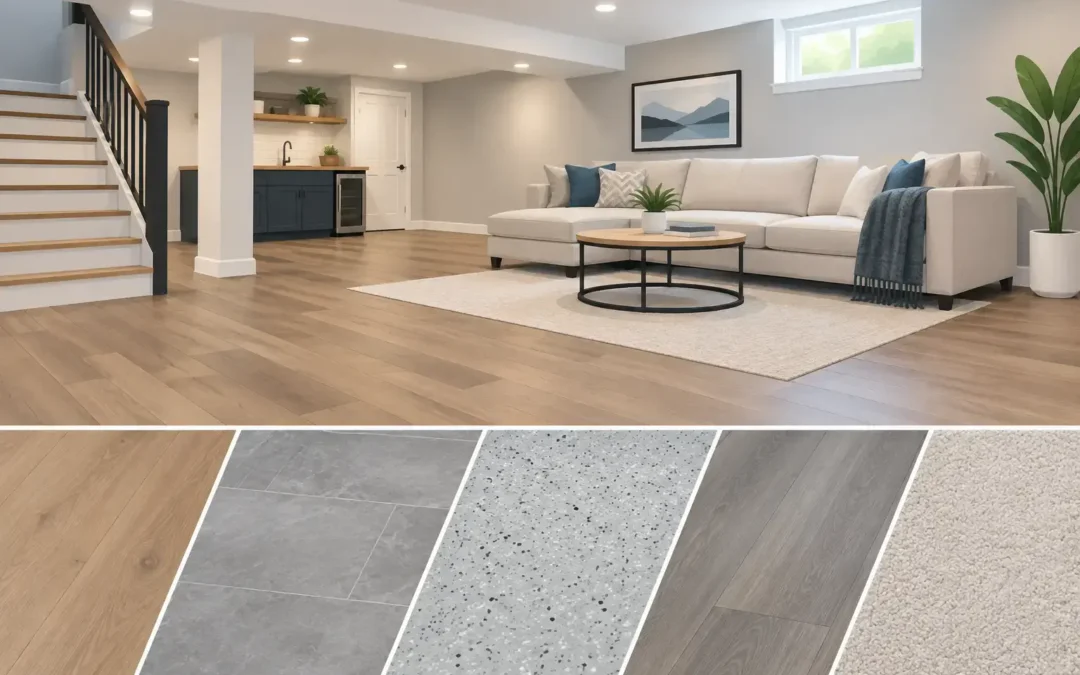
A basement floor has to handle more than day-to-day foot traffic. It sits over concrete, often below grade, and may be exposed to seasonal humidity, cold temperatures, or moisture movement. That is why the best basement flooring options are not always the same products that work upstairs. The right choice depends on how the space will be used, what condition the slab is in, and whether moisture has been properly addressed before finishing begins.
For a family room, home gym, rental suite, office, or finished recreation space, flooring should be selected as part of the complete basement plan. Subfloor height, ceiling clearance, insulation, drains, and transitions to stairs or adjacent rooms all matter. A good-looking floor installed over an unresolved moisture issue is still a costly mistake.
Start With the Basement, Not the Flooring Sample
Before comparing colours and finishes, assess the concrete slab and the surrounding conditions. In Ontario homes, basements can experience changing humidity through spring thaw, heavy rain, and hot summer months. Even a basement that has never visibly flooded may have elevated moisture vapour moving through the slab.
A contractor should check for cracks, uneven areas, previous water damage, and signs of efflorescence, which can appear as a white powder on concrete. The floor may need patching, levelling, or a moisture-control system before a finished product is installed. If there has been water intrusion, the source should be corrected first, whether that means exterior grading, drainage work, foundation repair, sump-pump improvements, or plumbing repairs.
Ceiling height also affects the decision. A raised subfloor can make a basement warmer and more comfortable, but it adds thickness. In a lower-ceiling space, a thinner flooring system may be the better practical choice.
Best Basement Flooring Options by Use and Budget
There is no single best material for every basement. The most reliable choice is the one that matches the room’s purpose and the home’s moisture conditions.
Luxury vinyl plank and luxury vinyl tile
Luxury vinyl plank, often called LVP, and luxury vinyl tile are among the most practical choices for finished basements. They are water-resistant or waterproof depending on the product, easy to maintain, and available in convincing wood, stone, and tile looks.
Vinyl works particularly well for recreation rooms, guest spaces, rental suites, and open-concept basements where homeowners want a consistent finish without the cost and moisture sensitivity of hardwood. Many click-lock products can float over a properly prepared slab or approved underlayment, which can help with installation efficiency.
The trade-off is that vinyl is only as smooth as the surface below it. A slab with dips, high spots, or cracks may telegraph through thinner material or create problems with locking joints. Quality matters too. Commercial-grade wear layers and a stable core generally perform better in busy households than bargain products.
Engineered hardwood
Engineered hardwood brings genuine wood character to a basement without relying on a solid wood plank. Its layered construction is more dimensionally stable than traditional hardwood, making it a better candidate for below-grade applications when the product is approved for that use.
This is a strong option for homeowners who want a refined, finished look in a dry basement lounge, office, or high-end suite. It can tie a lower level visually to the main floor and adds warmth that many synthetic products cannot fully replicate.
However, engineered hardwood is not waterproof. It should not be used where there is ongoing moisture, a history of water events, or a high risk of spills being left unattended. It also requires careful attention to vapour barriers, subfloor systems, and manufacturer installation requirements. A basement that feels damp in summer is usually better served by vinyl, tile, or another moisture-tolerant finish.
Porcelain or ceramic tile
Porcelain tile is one of the most durable basement flooring materials available. It is highly water-resistant, stands up to pets and heavy use, and works well in basement bathrooms, laundry rooms, entry areas, and spaces near a walkout door.
Porcelain is generally preferred over ceramic for demanding areas because it is denser and less absorbent. It also offers broad design flexibility, from large-format stone looks to clean, modern concrete finishes.
The main consideration is comfort. Tile over concrete can feel cold underfoot, especially during a York Region winter. Area rugs can help in living spaces, while in-floor heating can make tile a premium, comfortable choice when the renovation scope and budget allow. The slab must also be flat and properly prepared, as tile does not tolerate movement or poor substrate conditions well.
Laminate flooring
Modern laminate has improved significantly in appearance and durability. It can be an economical way to create a wood-look floor in a dry, finished basement, and many products offer better water resistance than older laminate systems.
Still, water-resistant is not the same as waterproof. If water enters through a foundation crack, appliance leak, or failed drain connection, laminate can swell at the seams and require replacement. It is best used in basements with a proven dry history and appropriate moisture protection below the flooring.
For homeowners working within a controlled budget, laminate can be a reasonable choice. For a basement suite, children’s playroom, or space with more uncertain moisture conditions, luxury vinyl is usually the safer investment.
Carpet and carpet tile
Carpet remains a useful option where warmth and sound control are priorities. It makes a basement family room, media room, or bedroom feel comfortable quickly, and it softens acoustics in spaces with large televisions, games tables, or home theatres.
The risk is obvious: carpet absorbs water. Traditional broadloom should only be installed in a dry basement with no known moisture concerns. If the area has had even minor water events, consider carpet tiles instead. Individual tiles can be lifted, dried, or replaced more easily than a wall-to-wall installation.
Use a basement-rated underpad or moisture-barrier system where appropriate. Avoid installing carpet directly over questionable concrete, as trapped moisture can create odours and mould concerns.
Polished concrete and epoxy coatings
For a modern, low-maintenance finish, concrete can be polished, stained, sealed, or coated with epoxy. These options are common in home gyms, workshop areas, utility spaces, and contemporary recreation rooms where a durable industrial look suits the design.
A polished concrete floor preserves ceiling height because it uses the existing slab. Epoxy can provide a clean, hard-wearing surface with strong stain resistance. Both options need proper substrate preparation, and epoxy is especially sensitive to moisture pressure and installation conditions.
Concrete is hard and cool, so it is less inviting for a traditional family room unless paired with rugs and thoughtful lighting. It is an excellent functional choice when durability matters more than softness.
Do You Need a Subfloor Under Basement Flooring?
In many cases, yes. A subfloor system can create a thermal break between the concrete and finished flooring, improve comfort, and help manage minor moisture vapour. Options range from dimpled membrane products to insulated panels and framed subfloor assemblies.
The best approach depends on the slab condition and the finished floor. Tile may use an uncoupling membrane rather than a raised subfloor. Vinyl may require a smooth, flat underlayment. Engineered hardwood often benefits from a more substantial and carefully designed subfloor system.
Do not add layers simply because they sound protective. Every layer affects finished floor height, stair risers, door clearances, and the location of appliances, bathroom fixtures, and baseboards. This is where a full-scope basement renovation plan prevents expensive adjustments later.
Flooring Choices to Avoid or Use Carefully
Solid hardwood is generally a poor fit for most below-grade basements. Natural wood expands and contracts with moisture changes, and concrete slabs create conditions that can lead to cupping, gaps, or damage. A dry basement is not necessarily a stable enough environment for solid wood over time.
Standard sheet vinyl can be cost-effective, but it can be punctured and may be difficult to repair if damaged. Low-cost peel-and-stick tiles can also fail when the slab has dust, moisture, or temperature fluctuations. These products may have a place in a temporary or low-traffic utility area, but they are rarely the best long-term answer for a finished basement.
Plan Flooring Around the Entire Renovation
The flooring decision should be made early, before framing is complete and well before trim is ordered. It affects the finished height of the room, bathroom transitions, stair details, door swings, and furniture placement. In a basement with a bathroom, wet bar, gym, or walkout entrance, it may make sense to use different materials in different zones rather than force one floor throughout.
For homeowners in the GTA and surrounding areas, a basement renovation is also an opportunity to address insulation, drainage, electrical upgrades, and layout changes at the same time. Green Machine Inc. approaches basement refinishing as a coordinated construction project, because the details behind the finished floor matter just as much as the material you see.
Choose a floor that suits the way your household will actually use the space, not just the sample board under showroom lighting. A properly prepared basement with the right flooring system will stay comfortable, durable, and easier to maintain for years to come.