
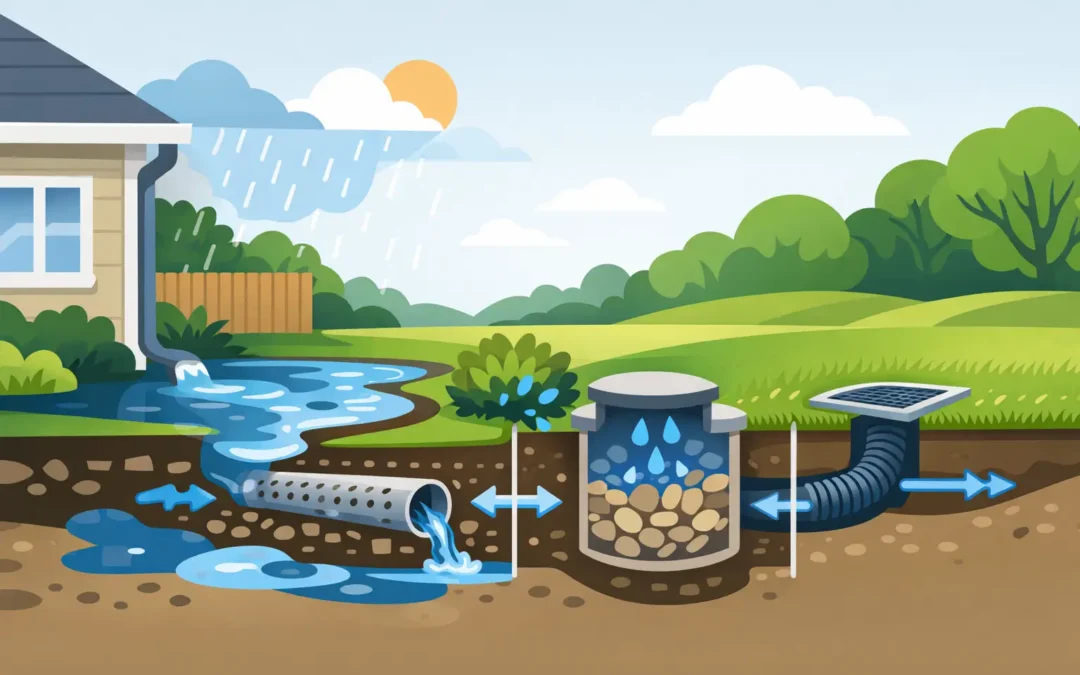
A backyard does not need much water in the wrong place to become a problem. One low spot near the patio, one downspout dumping beside the house, or one poorly graded lawn can turn a usable yard into a muddy mess. Good backyard drainage solutions are not just about drying things out – they protect foundations, hardscaping, turf, gardens, and the overall value of the property.
In Ontario, drainage issues often show up after spring thaw, heavy summer storms, or a long stretch of rain when the ground is already saturated. The right fix depends on where the water is coming from, how the yard is built, and what else sits around it, whether that is a pool, interlock patio, retaining wall, fence line, or basement walkout.
Why drainage problems get expensive fast
Water rarely stays where it first appears. It travels along the path of least resistance, and that means a small problem in one section of the yard can lead to damage somewhere else. You might first notice puddles on the lawn, but the bigger issue may be erosion under pavers, frost movement near a retaining wall, or moisture pressure building up against the home.
Poor drainage can also shorten the life of finished outdoor spaces. Interlock shifts, joints wash out, wood structures sit in damp conditions, and planted areas struggle because roots stay too wet. If a property has a pool, cabana, outdoor kitchen, or custom landscape work, drainage should never be treated as an afterthought.
The most common causes of backyard drainage issues
Most drainage problems come down to one or more site conditions working together. Improper grading is one of the biggest ones. If the yard slopes toward the house, garage, or a low-use area where water collects, surface runoff has nowhere to go.
Compacted soil is another frequent issue, especially on properties that have gone through construction or heavy equipment access. Water cannot absorb properly, so it sits on top. Clay-heavy soil, which is common in parts of Southern Ontario, makes this worse.
Downspouts are often part of the problem as well. If roof water is discharged too close to the foundation or into a small side yard with limited pitch, it can overwhelm the area quickly. In some yards, the issue is not one source but a combination of neighbour runoff, retaining walls, fences, raised gardens, and patios that block natural flow.
Backyard drainage solutions that actually work
The best backyard drainage solutions are built around the property, not picked from a generic checklist. What works on a flat suburban lot in Aurora may not be enough for a sloped cottage-country property or a backyard with multiple hardscape features.
Regrading the yard
If the main problem is slope, regrading is often the right starting point. This means reshaping the surface so water moves away from structures and toward an appropriate outlet area. In many cases, regrading solves the root cause instead of just managing the symptom.
That said, regrading is not always simple. Existing patios, decks, fences, tree roots, and utility locations can limit how much the grade can change. On a finished property, the work needs to be coordinated with landscaping and construction elements so the fix does not create a new problem elsewhere.
French drains and subsurface drainage
A French drain is useful when water needs to be collected below grade and redirected away from trouble spots. This type of system typically uses a perforated pipe set in clear stone and wrapped to reduce soil infiltration. It is often installed along foundations, behind retaining walls, or through persistently wet sections of lawn.
French drains are effective, but only when designed properly. Pipe depth, slope, stone volume, outlet location, and surrounding soil conditions all matter. A poorly installed system can clog, hold water, or discharge into another bad location.
Catch basins and channel drains
For hardscape surfaces like patios, pool decks, driveways, and walkways, surface collection is often the better answer. Catch basins collect water at low points, while channel drains are installed across areas where sheet flow needs to be intercepted.
These solutions are common around interlock, concrete, and other finished surfaces because they control water before it starts undermining the base. They are especially helpful where there is not enough room to reshape grade significantly.
Downspout extensions and discharge management
Sometimes the simplest fix is managing roof runoff properly. Downspouts should move water far enough away from the foundation and away from sensitive areas like window wells, planting beds, and patio edges.
This can involve above-ground extensions, buried solid pipe, or connection into a larger drainage plan. The key is to avoid dumping roof water into a part of the yard that is already struggling. If several downspouts all empty into one side yard, that area may never dry out no matter what else is done.
Dry wells and soakaway systems
A dry well or soakaway system can help where water needs a place to disperse gradually into the surrounding soil. These systems are useful on properties where direct discharge options are limited and where soil conditions allow for infiltration.
This is very much an it depends solution. In heavy clay, a dry well may fill faster than it drains. In a better-draining soil profile, it can work well as part of a broader drainage design.
Swales and landscape-based drainage
A swale is a shallow, sloped channel that guides surface water across the property in a controlled way. When properly built, it can look natural and fit into the landscape instead of standing out as a utility feature.
Swales work well on larger properties or yards where there is enough space to move water without hard infrastructure everywhere. They can also be paired with planting strategies that tolerate more moisture, which is often a smarter approach than trying to force every part of the yard to stay equally dry.
Drainage around patios, pools, and retaining walls
Finished backyards need a more coordinated drainage plan because every built feature changes how water moves. A patio that is perfectly level to the eye still needs enough pitch to shed water. A pool deck needs collection points that do not create trip hazards or visual clutter. A retaining wall needs drainage behind it so water pressure does not build up over time.
This is where design/build experience matters. Drainage should be planned at the same time as grading, base preparation, hardscape layout, and structural work. Trying to retrofit drainage after a project is complete is usually more disruptive and more expensive than doing it correctly from the start.
Signs you need professional drainage work
Some drainage issues are obvious, while others are easier to miss until damage starts showing up. Standing water that lasts more than a day or two after rain is a common warning sign. So is a lawn that stays soggy in one area while the rest of the yard dries normally.
You may also notice interlock settling, mulch washing away, staining on foundation walls, dampness near a walkout, or erosion along fence lines and garden edges. If the problem keeps returning after small fixes, there is usually an underlying grading or water management issue that needs a proper site assessment.
What a proper drainage plan should consider
A good drainage plan looks at the whole property, not just the wet spot. That includes roof runoff, property lines, neighbouring grades, soil conditions, low points, existing structures, and where collected water can legally and practically go.
In municipalities across York Region and the GTA, drainage work also needs to respect site constraints, local requirements, and the realities of close lot lines. What works on a wide rural property may not be suitable in a tighter subdivision backyard. The solution should also match the intended use of the space. A family yard, pool area, and commercial exterior each have different durability and performance demands.
For larger projects, drainage should be tied into the construction scope from day one. That is especially true when work includes interlocking, retaining walls, pool installations, additions, or full backyard transformations. Companies such as Green Machine Inc. handle these elements together because grading, excavation, hardscape, and water control all affect one another.
Cheap fixes vs long-term results
There is a reason some drainage problems keep coming back. Surface patching, a few bags of topsoil, or one extension hose may improve conditions for a while, but they often do not address the real cause. Water management is one of those parts of a project where shortcuts usually show up later.
Long-term results come from matching the fix to the site. Sometimes that means a straightforward regrade. Sometimes it means combining surface drains, subsurface piping, and landscape changes into one system. The right answer is rarely the flashiest one. It is the one that works through spring melt, heavy rain, and freeze-thaw cycles year after year.
A dry, stable backyard is not just easier to enjoy. It gives every other part of the property a better chance to last, from the lawn to the patio to the structure beside it. If water is starting to dictate how your yard functions, that is usually the point where a real drainage plan pays for itself.