
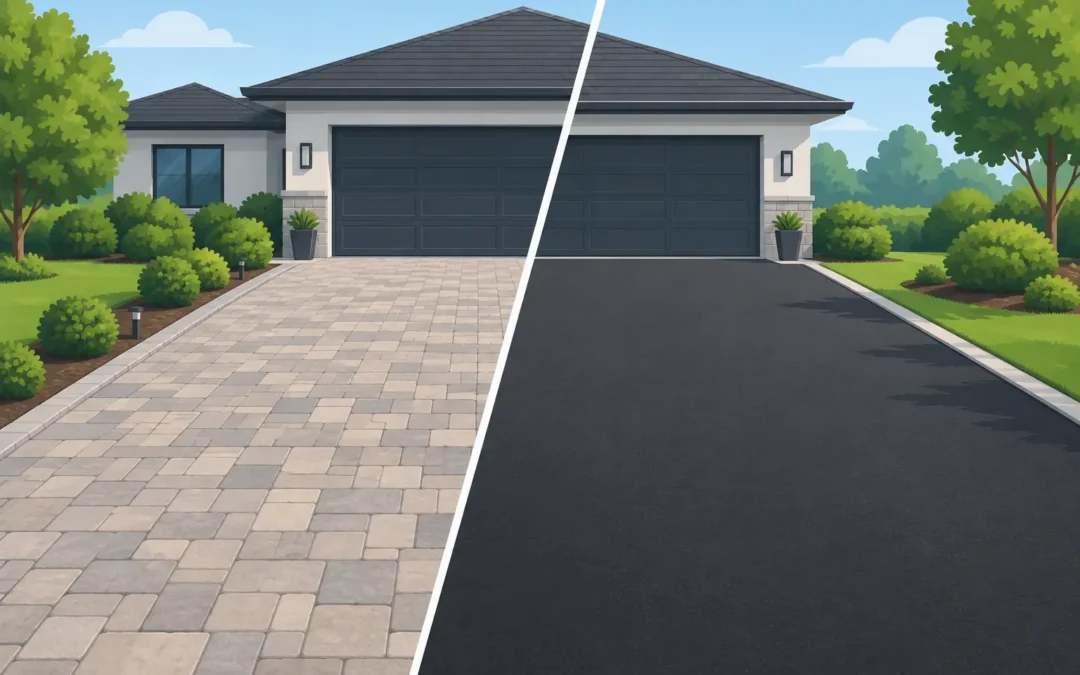
A driveway takes more punishment than almost any other finished surface on your property. It carries vehicles, absorbs summer heat, deals with road salt, and moves through Ontario freeze-thaw cycles year after year. When comparing pavers versus asphalt driveways, the right answer depends on more than the initial price. Site grading, drainage, expected use, design goals, and the condition of the base all matter.
For a straightforward parking area on a practical budget, asphalt can be a sensible solution. For homeowners planning a complete front-yard upgrade or a driveway that connects with walkways, retaining walls, and entrance stonework, interlocking pavers often offer more design flexibility and longer-term repairability. The key is choosing a material that fits the property and installing it properly from the ground up.
Pavers Versus Asphalt Driveways: The Main Difference
Asphalt is a flexible, dark-coloured paving material installed as a continuous surface over a prepared granular base. It is fast to install, provides a clean appearance, and is widely used for residential driveways throughout York Region and the GTA.
Interlocking pavers are individual concrete or natural stone units placed over a carefully compacted base, bedding layer, and edge restraint system. The finished driveway is made up of many pieces rather than one continuous slab. That changes how it handles repairs, movement, drainage, and visual design.
Neither material can overcome poor excavation or inadequate base preparation. A driveway may look excellent on installation day and still fail early if the subgrade is soft, water is trapped below the surface, or compaction is rushed. In Ontario, a properly built base is not an upgrade. It is the foundation of the job.
Upfront Cost and Long-Term Value
Asphalt usually costs less upfront than an interlocking paver driveway. It requires fewer finish materials and can generally be installed more quickly, especially on large, simple driveways. For owners who need reliable access and a clean surface without a major landscape redesign, that lower initial investment is attractive.
Pavers typically have a higher initial cost because the work includes more excavation, base preparation, installation labour, edge restraints, joint material, and detailed cutting around curves or borders. Premium paver styles, natural stone accents, inlays, and custom patterns add further cost.
The price conversation should not end there. Asphalt needs periodic sealing and eventually requires resurfacing or replacement as it oxidizes and cracks. Pavers also need maintenance, including joint sand replacement and occasional re-levelling, but damaged areas can often be lifted and repaired without replacing the entire driveway.
For a long-term home or a property where exterior presentation is a priority, pavers can provide strong value despite the higher initial investment. For a rental property, a large rural driveway, or a home with a tighter project budget, asphalt may be the better financial fit.
Winter Performance in Ontario
Winter is where the details of driveway construction become obvious. Frost movement, snow clearing, de-icing products, and spring runoff all test the surface and the base below it.
Asphalt remains somewhat flexible in cold weather, which helps it tolerate minor ground movement. However, water entering cracks can freeze, expand, and create wider breaks over time. Once cracking becomes extensive, patching can leave visible seams and may only be a short-term fix if the base has failed.
Pavers can move slightly as individual units, which is useful when the base is correctly built and contained. If a localized area settles or heaves, the affected pavers can be removed, the base corrected, and the same units reinstalled. That repairability is one of the practical advantages of interlock in Canadian climates.
Snow removal needs care with either option. Metal plow blades can catch raised pavers or scrape asphalt edges. A snowblower with skid shoes set correctly and a plow with a rubber cutting edge can reduce surface damage. Use de-icing products carefully, particularly on concrete pavers, and follow the manufacturer’s guidance for the product and paver type.
Maintenance Requirements
An asphalt driveway should be inspected each spring for cracks, edge breakdown, depressions, and areas where water sits. Small cracks should be sealed before moisture reaches the base. Many asphalt driveways benefit from sealcoating on a regular schedule, though the timing depends on the surface condition, traffic, and weather exposure.
Avoid parking heavy trailers, dumpsters, or construction equipment on asphalt during very hot weather. The material can soften and develop marks or depressions. Sharp turns from parked vehicles can also scuff the surface.
Pavers need a different kind of maintenance. The surface should be cleaned as needed, joints should be monitored for sand loss, and weeds should be addressed before they establish themselves. Polymeric joint sand can help stabilize joints and discourage weed growth when installed correctly. Over time, some driveways may need sections re-levelled, especially near downspouts, vehicle turning areas, or places with changing drainage conditions.
Pavers are not maintenance-free, but their maintenance is often more targeted. Rather than treating a crack across an entire surface, you can address the area that has actually changed.
Appearance and Design Flexibility
This is where pavers have a clear advantage. They can be installed in different laying patterns, colours, borders, and textures to complement brick, stone veneer, siding, garage doors, or front entrance steps. A driveway can transition naturally into a front walk, landing, patio, or retaining wall without making the property feel like separate projects were completed years apart.
Pavers also suit properties with curved entrances, circular driveways, parking pads, and detailed front-yard landscaping. Borders can define the driveway edge, while contrasting bands can add visual structure without overcomplicating the design.
Asphalt has a simpler, more uniform look. Fresh asphalt provides a crisp black finish that works well with many homes, particularly where the landscape design is clean and understated. It is not limited to plain rectangles, but it does not offer the same degree of customization as interlocking stone.
A good design should match the home and the neighbourhood. An elaborate paver layout may not suit every property, just as basic asphalt may feel unfinished beside a newly built stone entrance, custom landscaping, or premium outdoor lighting.
Drainage and Base Preparation Matter More Than Surface Choice
Water is one of the biggest causes of driveway failure. A driveway must be graded to direct surface water away from the garage, house foundation, and neighbouring properties. Downspouts should not discharge onto the driveway base, where repeated water flow can wash out material or create settlement.
Both asphalt and pavers need properly excavated and compacted granular foundations. The required depth depends on soil conditions, driveway use, drainage, and whether vehicles beyond standard passenger cars will use the area. A driveway for a family SUV has different demands than one serving delivery vehicles, work trucks, or a cottage property with trailers and equipment.
Pavers can also be designed with permeable systems in appropriate applications. These systems allow water to move through joints into a specially prepared aggregate base rather than running entirely across the surface. They require careful engineering and maintenance, but they can be useful where stormwater management is a key concern.
When Asphalt Is the Better Choice
Asphalt is often the right choice when budget, speed, and practical vehicle access lead the decision. It works well for large driveways where a paver installation would significantly increase the project cost. It also suits homeowners who prefer a simple, continuous surface and are comfortable following a regular maintenance plan.
It can be particularly practical when a driveway replacement is the main project, rather than part of a larger front-yard renovation. Provided the base and drainage are properly addressed, asphalt delivers dependable day-to-day performance.
When Pavers Are the Better Choice
Pavers are a strong choice for homeowners investing in curb appeal, custom landscaping, and long-term flexibility. They are well suited to front entrances, circular driveways, courtyard-style layouts, and homes where the driveway needs to coordinate with stone steps, walkways, walls, and outdoor living areas.
They also make sense when future access matters. If underground utilities need work or a section settles, pavers can be lifted and reinstalled with far less visible disruption than a patched asphalt surface. This is especially valuable on established properties where landscape details and finished surfaces are expected to last.
Make the Decision Around Your Whole Property
The best driveway is not always the least expensive surface or the most decorative one. It is the one built for your site, your vehicles, your drainage conditions, and the level of finish you expect from the property. Before selecting materials, assess the existing base, identify where water goes during heavy rain and spring melt, and consider how the driveway connects to the rest of the landscape.
For a complete exterior project, Green Machine Inc. can coordinate the driveway with grading, interlocking, stonework, walkways, retaining walls, and surrounding landscape construction. A clear plan at the start helps ensure the finished driveway looks right, drains properly, and continues to perform through the seasons.